
Weekly Bible Study Notes and Worship Resources for Ordinary 26
Year C, Colour = Green
Quick Navigation Links
Introduction
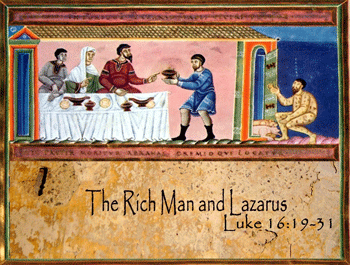
Today we have the story of Lazarus, which incorporates these blessings and curses. The rich man is dressed in purple and fine linen, both of these things indicate great wealth. Contrast this with poor Lazarus, who is reduced to a life of begging. He is not adorned in fine clothes rather the words used describe his skin covered in ulcerated sores, which would have made him unclean. His only companions are wild dogs. He is left at the gate of the rich man, the gate emphasising the size of the rich man’s estate and the separation which exists between them. If Lazarus had received even the scraps from the rich man he would have perhaps survived, the gates allowed the rich man to shut out Lazarus and prevent the needs of Lazarus from becoming his concern. People build gates on their homes not because they want to be kept in, rather because they want to keep others out. They wish to remain protected from the world beyond. The gate is very symbolic and challenges us all to consider whether we are remote and isolated from the needs of our wider society. Every day the rich man would have gone past Lazarus, yet he might never have even noticed that he was there. How many times are we just too preoccupied with our own lives that we fail to notice those with great need?
Opening Verse of Scripture
If you make the Most High your dwelling-- even the LORD, who is my refuge-- then no harm will befall you, no disaster will come near your tent. For he will command his angels concerning you to guard you in all your ways; they will lift you up in their hands, so that you will not strike your foot against a stone.
Collect Prayer for the Day — Before we read we pray
God, who in generous mercy sent the Holy Spirit upon your Church in the burning fire of your love: grant that your people may be fervent in the fellowship of the gospel that, always abiding in you, they may be found steadfast in faith and active in service; through Jesus Christ your Son our Lord, who is alive and reigns with you, in the unity of the Holy Spirit, one God, now and for ever. Amen CW
Lord God, defend your Church from all false teaching and give to your people knowledge of your truth, that we may enjoy eternal life in Jesus Christ our Lord. CW
First Bible Reading Amos 6: 1a & 4—7 6:1a
Thus says the Lord, the God of hosts: Alas for those who are at ease in Zion, and for those who feel secure on Mount Samaria! Alas for those who lie on beds of ivory, and lounge on their couches, and eat lambs from the flock, and calves from the stall; who sing idle songs to the sound of the harp, and like David improvise on instruments of music; who drink wine from bowls, and anoint themselves with the finest oils, but are not grieved over the ruin of Joseph! Therefore they shall now be the first to go into exile, and the revelry of the loungers shall pass away. NRSV
Second Reading 1 Timothy 6 : 6 - 19
There is great gain in godliness combined with contentment; for we brought nothing into the world, so that we can take nothing out of it; but if we have food and clothing, we will be content with these. But those who want to be rich fall into temptation and are trapped by many senseless and harmful desires that plunge people into ruin and destruction. For the love of money is a root of all kinds of evil, and in their eagerness to be rich some have wandered away from the faith and pierced themselves with many pains.
But as for you, man of God, shun all this; pursue righteousness, godliness, faith, love, endurance, gentleness. Fight the good fight of the faith; take hold of the eternal life, to which you were called and for which you made the good confession in the presence of many witnesses. In the presence of God, who gives life to all things, and of Christ Jesus, who in his testimony before Pontius Pilate made the good confession, I charge you to keep the commandment without spot or blame until the manifestation of our Lord Jesus Christ, which he will bring about at the right time – he who is the blessed and only Sovereign, the King of kings and Lord of lords. It is he alone who has immortality and dwells in unapproachable light, whom no one has ever seen or can see; to him be honour and eternal dominion. Amen.
As for those who in the present age are rich, command them not to be haughty, or to set their hopes on the uncertainty of riches, but rather on God who richly provides us with everything for our enjoyment. They are to do good, to be rich in good works, generous, and ready to share, thus storing up for themselves the treasure of a good foundation for the future, so that they may take hold of the life that really is life.NRSV
Gospel Reading Luke 16: 19 - 31
Jesus told this parable to those among the Pharisees who loved money: ‘There was a rich man who was dressed in purple and fine linen and who feasted sumptuously every day. And at his gate lay a poor man named Lazarus, covered with sores, who longed to satisfy his hunger with what fell from the rich man’s table; even the dogs would come and lick his sores. The poor man died and was carried away by the angels to be with Abraham. The rich man also died and was buried. In Hades, where he was being tormented, he looked up and saw Abraham far away with Lazarus by his side. He called out, “Father Abraham, have mercy on me, and send Lazarus to dip the tip of his finger in water and cool my tongue; for I am in agony in these flames.” But Abraham said, “Child, remember that during your lifetime you received your good things, and Lazarus in like manner evil things; but now he is comforted here, and you are in agony. Besides all this, between you and us a great chasm has been fixed, so that those who might want to pass from here to you cannot do so, and no one can cross from there to us.” The man who had been rich said, “Then, father, I beg you to send him to my father’s house - for I have five brothers - that he may warn them, so that they will not also come into this place of torment.” Abraham replied, “They have Moses and the prophets; they should listen to them.” He said, “No, father Abraham; but if someone goes to them from the dead, they will repent.” Abraham said to him, “If they do not listen to Moses and the prophets, neither will they be convinced even if someone rises from the dead.”’ NRSV
Post Communion Prayer
Keep, O Lord, your Church, with your perpetual mercy;
and, because without you our human frailty cannot but fall,
keep us ever by your help from all things hurtful,
and lead us to all things profitable to our salvation;
through Jesus Christ our Lord.CW
Commentary Wealth Warning
We seem to be getting many weather warnings being issued as we move towards the autumn. Today’s gospel reading perhaps comes as something of a ‘Wealth Warning’. The rich man in the parable was content in his wealth until it came to the time of death. The rich man, and the people Amos addressed, were content with their wealth and state of living but seemed to lack any sense of real Godliness in their lives. They seemed to be content with chasing after the, so called, finer things of life. Pursuing their own sensuous happiness and desires with little or no thought for those around them, especially those in crippling need and poverty. They pushed them aside in pursuit of their own objectives and personal satisfaction. In the preceding verses in Amos we have the words we were reminded of last week as God cries out for ‘…justice to roll down like waters and righteousness like an everlasting stream’.
The word which describes the rich man’s gate depicts a significant edifice (it could be where we get the word pile or pylon from) so it wasn’t just a small garden gate where Lazarus sat each day. Presumably it was an impressive gate leading to an impressive inner courtyard and equally impressive house. It was the equivalent what we might see in a high wall and electronic security gate in today’s world. The rich man had not mistreated Lazarus, just ignored him, treated him as if he did not exist, perhaps hoped he’d go away Indeed, he didn’t exist inside the confines of the rich man’s inner world and his house and was probably very really ‘out of sight and out of mind’. Even when the rich man is tormented in death, he doesn’t recognise Lazarus as a person in his own right, as an equal individual before God, he sees him more as someone who is at his beck and call, someone to do his bidding. It’s as if he was in his rich house and surroundings once more. Nothing seems to have changed. He still has no sense of responsibility to Lazarus, no remorse or even sadness as he realises how he has been treated during his life. Last week’s reading illustrated the importance of using our own earthly possessions towards well-being. This story continues in this vein. The rich man hadn’t even offered Lazarus the scraps from his table it would seem, and now he and his family were in eternal peril. Now when he does notice him it’s not out of any sense of compassion or remorse, it’s as a resource to be used.
The community that is addressed in the Epistle to Timothy appears to be a settled church. It has a clear order and structure and an emerging sense that the church is having to look to the longer term. It’s beginning to consider how Christians might be called to relate to each other in a world where the return of Christ apparently is not be as imminent as was first thought. It’s clear that there is also a breadth of social standings within the church, with some members being well off and others less so. Today’s passage seems to be aimed at those who are somewhat wealthy in the church, although the phrase, ‘The love of money is the root of all kinds of evil’, is equally applicable to all, no matter where they happen to be on the social or financial spectrum. The love of money leads to seeing things other than God and the eternal as the most important things in life. More importantly it can lead to overlooking things and people, not seeing the things and people that are and should be important and that do require our attention, such as Lazarus by the rich man’s magnificent portico gate.
The epistle reminds us that our status in God is not dependent on earthly possessions and wealth. We are called to love God, love ourselves and love our neighbours. Sometimes we can forget our love of God and slip into loving ourselves but ignoring the needs of our neighbours, those who sit at our metaphorical gates. Sometimes we just find it difficult to love God, or ourselves, and therefore even more difficult to love others who may be in need. St Teressa of Avila wrote in her work, ‘The Interior Castle’, “Our Lord asks but two things of us: love for Him and for our neighbour…. I think the most certain sign that we keep these two commandments is that we have genuine love for others. We cannot know whether we love God although there may be strong reasons for thinking so, but there can be no doubt about whether we love our neighbour or no’.
The gospel story has many parallels with legends which were well known in the first century, where its requested that a person comes back from the dead with a waring of what is to come in the hereafter. In the stories that the hearers and readers of the early gospel would be familiar with, this request was normally granted. In this case Jesus points out that there are numerous references in scripture as to what will happen, they could see from the Old Testament that their behaviour and attitude was out of line with God’s desire and expectations. Even someone returning from the dead, the resurrection, would not convince them otherwise. But the life and riches of the coming age, foreseen in Jesus show where true wealth, identity and eternal security, hope and a home are to be found. The current riches of the world, given to us by God, are to be used to reveal this future hope and glorious inheritance and it breaks through in the Kingdom of God today. Sam Cappleman
St Teresa of Avila wrote in The Interior Castle:
'Our Lord asks but two things of us: love for him and for our neighbour. . . I think the most certain sign that we keep these two commandments is that we have a genuine love for others. We cannot know whether we love God, although there may be strong reasons for thinking so, but there can be no doubt about whether we love our neighbour or not.'...
The gospel reading illustrates well the point that Jesus has been making in this chapter several times already. That the wrong attitude to wealth can cause a great divide, a huge chasm, between a person and God. The rich man, it appears, has cut himself off and insulated himself from others by his attitude to wealth. In contrast, Lazarus has a friend in Abraham in heaven. When the rich man sees this, he begs that Lazarus goes from the dead to warn his brothers of the bigger eternal picture and the implications of depending purely on temporal earthy security and wealth. Abraham replies that even if someone rose from the dead (as Jesus did) they would not be convinced. Some commentators believe the last verse may have been inserted to express the frustration that many felt in the early church and the attitude to the resurrection, which was by then, some time away. The resurrection is the ultimate demonstration that there is a new and better way, good news for all. The old order of decay has passed away and a new order of life has come. It seems today that questions around the resurrection have moved on from whether it could possibly be true to whether it matters at all, whether it happened or not. There seems to be an ever-increasing gulf between those who believe in the resurrection (Christians) and those who just don’t seem to care about it anymore. Our challenge is to bridge that gap. Perhaps one way we can do this is by increasingly reflecting, engaging and acting with others on some of the moral and ethical issues in our society which are important to them as we can begin to explore the more eternal and truly critical issues of life, death and eternity which have far more significant implications on who we are and how we live. Sam Cappleman
Hymns
- to God be the glory
- I will enter his gates
- Be thou my vision
- The Kingdom of God
- Fill thou my life
Prayers for Sunday and the week ahead

- Lord, thank you for this building
- Where we come for cleansing,
- Where we gather around your table
- Where we sing aloud your praise
- Where we proclaim all that you have done for us Lord
- we love the house where you meet us,
- the place where your glory dwells
- In the assembly of your people
- we stand and praise the Lord. Amen.
- From Psalm 26
Your are never tired, O Lord, of doing us good. Let us never be weary of doing you service. But as you have pleasure in the well-being of your servants, let us take pleasure in the service of our Lord and abound in your work and in your love and praise evermore.
O Lord our God, under the shadow of your wings we will rest. Defend us and support us, bear us up when we are little, and we know that even down to our grey hairs you will carry us. St Augustine
Gracious father, we pray for peace in the world: for all national leaders that they may have wisdom to know and courage to do what is right; for all men and women, that their hearts may be turned to yourself in the search for righteousness and truth; for those who are working to improve international relationships, that they may find the true way of reconciliation; for those who suffer as a result of war: the injured and disabled, the mentally distressed, the homeless and hungry those who mourn their dead and especially for those who are without hope or friend to sustain them in their grief. Baptist peace fellowship.
Across the barriers that divide race from race: Across the barriers that divide rich from poor: Across the barriers that divide people of different faiths: Reconcile us, O Christ, by your cross (World Council of Churches Vancouver Assembly)
Additional Resources
Opening Verse of Scripture Psalm 91:91-10
If you make the Most High your dwelling-- even the LORD, who is my refuge-- then no harm will befall you, no disaster will come near your tent. For he will command his angels concerning you to guard you in all your ways; they will lift you up in their hands, so that you will not strike your foot against a stone.
Collect Prayer for the Day - Before we read we pray
Father of all, you gave your only Son, to take upon himself the form of a servant and to be obedient even to death on a cross. Give us the same mind that was in Christ Jesus that, sharing in his humility, we may come to be with him in his glory; for he lives and reigns with you, in the unity of the Holy Spirit, one God, now and for ever. Amen.
Commentary
We have a parable from Jesus today which tells about a rich man and a poor man, how one lives in luxury whilst the other one suffers miserably. When they die the rich man looks from afar at the poor man who has been welcomed by Abraham. It’s a pearly gates type story, but make no mistake this is not about who gets into heaven and who doesn’t, it is about redistribution of wealth.
In the minds of the Jewish leaders who heard the words of Jesus, the parable today would have been shocking and offensive. They believed that after death there would be a reversal of fortune, the righteous Israel would be exalted above those who had opposed them. To have been a child of Abraham would bring great reward. There are many different pictures in scripture of what happens to us when we die, but Jesus uses this idea of reward in the after life as a means to make an important teaching about this life. This is not a teaching about what happens when we die, it is a challenge about how we live in the here and now. Jesus is using one of the pictures in the minds of his hearers as a means of teaching us about our possessions. This is not confirmation that Jesus believes lots of people will be tormented in hell when they die, it is reminding us that many people suffer from poverty today.
Luke in his Gospel keeps coming back to the teachings of Jesus about possessions and their use, throughout his gospel, the poor have a special place. Luke recalls Jesus telling the Pharisees that they are ‘Lovers of Money’ (16:14) and Jesus makes clear that he has no time for those who exalt themselves or make show of their wealth without care for the poor. There will be a bipolar reversal of rich and poor, the proud and humble, such as that announced in the Magnificat in the first chapter of the Gospel.
In the story the rich man is not portrayed as a bad person, let alone an overt evil-doer. His crime is simply one of his self preoccupation which prevents him from caring about others. The man is very rich and very privileged, wearing garments of purple suggests some link with royalty and having a gate and a wall implies a large estate. The man goes about his life and he just fails to notice the plight of the poor man Lazarus who is a beggar in desperate poverty. The only attention paid to Lazarus is by dogs who lick his wounds. Much has been made of the healing properties of dogs saliva, but those hearing the teaching would be mindful of the fact that dogs were considered unclean. It is another interesting contrast that the only ones who bother with Lazarus are animals considered unclean.
The poor man dies and is carried to Abrahams bosom. The rich man also dies and is buried and finds himself in Hades which is a Greek place of the dead, the nether world of shades. The importance is not the geography of death but the unexpected reversal of fortune. God has changed the place of these two individuals. It is meant to be another one of those shockers which Jesus uses to wake up his audience.
He is telling those who ignore the poor to watch out !
It is significant that the rich man is not named. That's not unusual in Jesus' parables, whose main characters are just called, "a sinner," "a sower," "a woman," "a merchant of fine pearls," "a master" "a servant," etc. However In this parable something unique happens, the poor man is given the name, Lazarus, which means ‘God has helped’. The one who in his lifetime is ignored, not worth a second glance (except by those dogs who had more pity on him than the humans in the story), is the one who is singled out and named.
If the status of Lazarus before God was measured on his possessions then he would have been ignored. However the parable shows us that, despite what seemed to be a cursed existence of extreme poverty he was indeed favoured by God. This is a really important message - even though the world may consider some life to be cheap and unimportant, God notices the poor and he cares about the conditions in which they live and how they are treated. In the parable in another reversal, the rich man asks Abraham to get Lazarus to help him. He recovers a concern for others, albeit limited to the male members of his own family. Of course the message of the parable is that the time for caring is now, not when we are dead. The words which we should heed are those of Jesus, the one who has proved the truth of his words by his death and resurrection.
Of course some of this can come as a disappointment for us religious folk. We believe that God wants our prayers, our worship, our religious observance. It is daunting to think that our favour with God is not based on our creeds but on our behaviour towards to poor. We are invited today to take the place of the brothers in the story. We are given a chance which was not afforded to the rich man in the story. We can listen to the one who was raised and take heed of the warning which he gives that we must care for the poor. Although we sometimes have real problems balancing our personal budgets we are nevertheless excessively rich compared to 10% of the world population who earn less than $2 a day. There are also those like Lazarus in our own community who feel ignored and left out. This parable is about the destructive apathy and neglect which creates a chasm between rich and poor. There is no clear prescription of exactly what we are to do with our money and our possessions. Jesus called some to leave everything behind and follow him. Others had houses where they were able to offer hospitality. In the passage today the challenge is simply that it is not acceptable to ignore the poor and those in need. There is no room for indifference. Each one of us will have to examine ourselves to see how we respond, but none of us can be complacent about our possessions or our wealth. Charles Royden
Commentary
Through Luke we have been hearing Jesus speak about the dangers of money and once again today Jesus is speaking to the Pharisees, who were rich men about the dangers of wealth. The dangers of wealth are so important that one out of every seven passages in Luke is about money and wealth. We need to remember that 95% of people in Palestine at the time of Jesus were desperately poor. It was a huge social and economic problem and Jesus doesn’t dodge the political challenge. The contrast which Jesus makes in Luke is so stark that it seems difficult to imagine these words on his lips
Blessed are you who are poor, 6:21., Woe to you who are rich 6:24.,
Blessed are you who are hungry 6:22., Woe to you who are well fed. 6:25
Today we have the story of Lazarus, which incorporates these blessings and curses. The rich man is dressed in purple and fine linen, both of these things indicate great wealth. Contrast this with poor Lazarus, who is reduced to a life of begging. He is not adorned in fine clothes rather the words used describe his skin covered in ulcerated sores, which would have made him unclean. His only companions are wild dogs. He is left at the gate of the rich man, the gate emphasising the size of the rich man’s estate and the separation which exists between them. If Lazarus had received even the scraps from the rich man he would have perhaps survived, the gates allowed the rich man to shut out Lazarus and prevent the needs of Lazarus from becoming his concern. People build gates on their homes not because they want to be kept in, rather because they want to keep others out. They wish to remain protected from the world beyond. The gate is very symbolic and challenges us all to consider whether we are remote and isolated from the needs of our wider society. Every day the rich man would have gone past Lazarus, yet he might never have even noticed that he was there. How many times are we just too preoccupied with our own lives that we fail to notice those with great need?
Remember that we are not told in this parable that the rich man had done anything wrong. He was not necessarily somebody who had stolen, indulged in financial exploitation or whatever, his crime was simply one of indifference. Like us he failed to get angry at the plight of those who suffered and in this he created a wide gulf between himself and those in need. As our country suffers from the belt tightening exercises caused by our debt crisis, there will inevitably be those who suffer and often the burden falls disproportionately on the poor. Recently I visited Furniture Link in Bedford to learn about the invaluable work which they do in our community. I felt strongly that organisations such as this which provide a lifeline to those who have not got huge wealth will be increasingly important in the coming years.
We are told that Lazarus dies and the angels carry him to the bosom of Abraham. No doubt he would have had little ceremony at his passing, yet despite the manner of his funeral, he goes straight to "the bosom of Abraham." When the rich man dies he would undoubtedly receive a fine burial, but this is ineffective and he goes, to Hades, the place of the dead. Hades is a Greek term, like the Hebrew concept of the "underworld," or sheol. It brings to mind the understanding of the world in very primitive cosmology as the earth in the middle, heaven above and the underworld below.
This should not be read as story of heaven and hell, rather the fulfilment of the blessings and curses which we have read about in the beatitudes. The poor Lazarus goes not to heaven but to Abraham and is fed, the rich has the tables turned and is deprived. Jesus exhalts Lazarus by using his name, (which means ‘the one God helps’) the rich man in kept anonymous, as he were of less importance.
The rich man understandably pleaded with Abraham and calls him, ’Father Abraham’. We cannot read this without thinking back to Chapter 3:8-11 where John the Baptist berates those who claim to have Abraham as their father but fail to look after the poor. The rich man pleads for mercy but Abraham is unable to help because of the great divide between. The plea for mercy made by the rich man, echoes the lack of mercy which he had shown to poor Lazarus.
The story should not be read a theological exposition of what happens when you die, rather as a warning of how you should live. In scripture there are conflicting ideas represented about what happens when you die. In this story there is a choice of Abraham and Hades, whilst on the cross Jesus gives assurance of paradise on the same day, and in the New Testament there is also described a general resurrection of the dead when bodies are raised from sleep. Nobody knows what to expect, but the teaching is the same, prepare now in this life for what will take place in the next. Those who work to support groups like Furniture Link, Emmaus, Bechar etc. These people are wise, for Jesus himself encourages us to make friends with the poor so that when we die they will make representations on our behalf and allow us to have a heavenly home (16:9). I notice that this week in Partnership News there are requests for volunteers to help with Clubhouse at St Mark’s for those with learning Difficulties and Prebend day Centre. The needs are endless. It has been said that if Hitler is saved it will be through the prayers of the people he killed. Who knows, if the rich man had been a better neighbour, would Lazarus have been able to shout out to Abraham to show mercy ? Charles Royden
Commentary
Luke seems to think that judgement takes place soon after we die. It is he who tells us that Jesus promised one of the thieves on the cross that he would join him in paradise that day. John's gospel and Hebrews also appear to assume that people will enter heavenly glory directly after death and it came to be the common view in Christendom. Other parts of the New Testament assume a judgement day after a period of sleep. Jesus will appear, the dead will be raised and all face judgement. Then comes the transformation, the new creation. I start by saying this, to draw attention to the fact that there are in scripture many pictures about what happens when we die. Jesus is using one of those pictures as a means of teaching us about our possessions. This is not confirmation that Jesus believes lots of people will be tormented in hell when they die!
Luke in his Gospel keeps coming back to the theme of possessions and their use, throughout his gospel, the poor have a special place. The rich man is not portrayed as an overt evil-doer. His crime is his self preoccupation with which he prevented himself from caring about others as he cared for himself. The man is very rich and very privileged, wearing garments of purple suggests some link with royalty. Having a gate and a wall implies a large mansion. Have you noticed that the rich man is not named? That's not unusual in Jesus' parables, whose main characters are just called, "a sinner," "a sower," "a woman," "a merchant of fine pearls," "a master" "a servant," etc. In this parable something unique happens, a character is given a name. The one who in his lifetime is ignored, not worth a second glance (except by the dogs who lick his sores-what a touch, dogs had more pity on him than the human in the story), is the one who is named, singled out, given center stage, called Lazarus. The name means: 'God has helped' - no one else was going to! If Lazarus judged his status before God based on what he had, he would have had no tangible sign of God's favor. But the parable shows us that, despite what seemed to be a cursed existence, he was indeed favored in the eye of God. The world may be deaf and blind to us, but God never is. The rich man asks Abraham to get Lazarus to help him. What a reversal! Give him credit, the rich man then recovers some concern for others, but limited to his own family, his brothers (we can only hope that he had no sisters!).
Although we sometimes have real problems balancing our personal budgets we are rich as the world sees it and knows it, and Lazarus is at the gate. Lazarus is at the gate here in this community, and he is at the gate around the world. This parable targets the violence of apathy and neglect which is widening the chasm between rich and poor. Luke never really gives us a clear prescription of what exactly we are to do with possessions. Some, like Jesus' disciples, must leave all behind to follow Jesus. Yet it is clear that Mary, Martha and Lazarus didn't, since they had a house in which they offered hospitality to Jesus and his disciples. Zacchaeus, the reformed chief tax collector, is lauded for giving half of his possessions to the poor. He didn't have to give all. With thoughtful consideration, each of us will have to make up our own mind how we respond. Certainly this gospel will not leave us complacent about our possessions or our wealth. They can be used to help the poor or they will be a stumbling block in our following Christ. There isn't much room for manoeuvre. Is it possible that our possessions, which many call a "blessing from God," may indeed be what blinds us and keeps us distant from God? Charles Royden
Meditation
The 'Pink Panther' comedy films starred Peter Sellers as Inspector Clouseau, with Herbert Lom as Chief Inspector Dreyfus. Clouseau, speaking with an outrageous French accent that leads people to query what he is saying, bungles all that he does and creates trouble for everyone around. Yet he always wins through and captures the criminals who sometimes find him so frustrating that they give themselves up. At the start of the 1976 film, 'The Pink Panther Strikes Again', a real-life French-man is quoted. Émile Coué had recommended to patients that they recite some words up to 30 times a day, and it is these words that are quoted in the film: "Each day and in every way I am becoming better and better." Coué's idea was that this would be a way of getting people to realise that, if they are positive about life, they have the potential to be able to help themselves in some ways. In 1922, whilst on a ship approaching New York, a 100-miles-an-hour gale made most people very sea-sick. It was reported that Émile Coué was not sick, but was repeating to himself in his own language: "Each day and in every way I am becoming better and better."; Let us pray:
Lord God, keep in me a sense of humour and the ability to laugh at myself. Lead me always to be positive, looking for the best in people and in situations. Each day and in every way may I grow in the love of the Father and the presence of the Son, and the power of the Holy Spirit. Amen.
Meditation
The psalmist reminds us of the inseparable connection between loving God and caring for the poor. There are many reasons to care for the poor and the vulnerable, but our ultimate motivation is based in the character of God himself. In three short verses Psalm 146:7–9 reveals the tender action of God for people in trouble. Notice the different vulnerable groups of people mentioned:
- He upholds the cause of the oppressed
- and gives food to the hungry.
- The Lord sets prisoners free,
- the Lord gives sight to the blind,
- the Lord lifts up those who are bowed down,
- the Lord loves the righteous.
- The Lord watches over the alien
- and sustains the fatherless and the widow,
- but he frustrates the way of the wicked.
Dogs in the Biblical and rabbinic traditions are almost as unclean as pigs. Both the Hebrew and Greek scriptures are clear witnesses to this. Dogs are kept as guard dogs (Isaiah 56:10), never as pets. Only those who feed them dare approach them. A rich man needs such dogs because they are his "home security system." The story assumes that the guard dogs are fed the scraps Lazarus longs to eat (cf. Matthew 15:27). Lazarus goes hungry. The dogs are fed. Yet, those wild guard dogs, whom no one but their handlers dare approach, realize that the weak, sick man by the gate is their friend. They lick his wounds. The saliva of a dog's mouth is sterile. The ancients discovered that when a dog licks a person's sores or wounds, healing occurs more rapidly. Archeologists in Aschelon, Israel have recently uncovered a center where 1300 dogs are buried in individual plots. The site has been identified as a Phoenecian semi-religious center where the sick could go, pay a fee and have trained dogs lick their wounds as medical treatment. In this parable the master refuses to help the poor sick man outside his gate - but his wild guard dogs will do what they can. They will lick his wounds. Their master will not help Lazarus. They will. Lazarus' quiet gentle spirit breaks through their violent hostility to humans and they care for him knowing that he cares for them. Taken from Kenneth E. Bailey, Author and Lecturer in Middle Eastern New Testament Studies Research Professor of NT at the Ecumenical Institute, Jerusalem (Emeritus) Canon Theologian of the Episcopal Diocese of Pittsburgh
Prayers for Sunday and the week ahead
Let your mighty hand and your outstretched arm, O Lord, be our defence. Let your mercy and loving-kindness in Christ Jesus be our protection. May your kind and faithful Word be our instruction and guide; and may the grace of your life-giving Spirit be our comfort and strength, to the end and in the end, now and for ever. Amen. John Knox, 1513-1572
O most loving Shepherd, in the deepest of all waters we will trust you. In the darkest of all valleys we will rejoice in your presence. In the worst of our days we shall rest at peace in your arms. In the most troubled of our nights we shall be comforted by your saints. Amen. Archibald Campbell Tait, 1811-1882
Hymns
- O worship the Lord
- The trumpets sound
- We cannot measure
- Glory to God
- I will sing the wondrous story .
Prayers of Intercession
In the power of the Spirit,
and in union with Christ,
let us pray to the Father.
Father in heaven,
by his blood your Christ has ransomed us to you,
and has made us a kingdom and priests to you our God.
As the angels minister to you in heaven,
strengthen your Church to serve you here on earth.
Lord, hear us,
Lord, graciously hear us.
Father in heaven,
when the angels greeted the birth of your Son
they sang for joy ‘Glory to God and peace on earth’.
Bless with Christ’s peace the nations of the world.
Lord, hear us,
Lord, graciously hear us.
Father in heaven,
your Son has promised to your children
the care of the guardian angels who look upon your face.
Protect by your mercy our neighbours, families and friends.
Lord, hear us,
Lord, graciously hear us.
Father in heaven,
you give your angels charge over those who trust in you
to guard them in all their ways.
Be with those in trouble …,
rescue them and show them your salvation.
Lord, hear us,
Lord, graciously hear us.
Father in heaven,
your angel declares ‘Blessed are the dead who die in the Lord.’
‘Blessed indeed,’ says the Spirit,
‘for they may rest from their labours,
for they take with them the record of their deeds.’
Enfold in your love [… and] all who come in faith
to your judgement seat in heaven.
Lord, hear us,
Lord, graciously hear us.
Father in heaven,
the angels sing by day and night around your throne:
‘Holy, holy, holy is the Lord God almighty.’
With Michael, prince of the angels, who contends by our side,
with Gabriel, your herald, who brings glad tidings,
with Raphael, the protector, who ministers your healing,
and with the whole company of heaven,
we worship you, we give you glory,
we sing your praise and exalt you for ever.
Amen.
Prayers of Intercession
God the Father, your will for all people is health and salvation.
AllWe praise and bless you, Lord.
God the Son, you came that we might have life,
and might have it more abundantly.
AllWe praise and bless you, Lord.
God the Holy Spirit, you make our bodies
the temple of your presence.
AllWe praise and bless you, Lord.
Holy Trinity, one God, in you we live and move and have our being.
AllWe praise and bless you, Lord.
Lord, grant your healing grace to all who are sick, injured
or disabled,
that they may be made whole.
AllHear us, Lord of life.
Grant to all who are lonely, anxious or depressed
a knowledge of your will and an awareness of your presence.
AllHear us, Lord of life.
Grant to all who minister to those who are suffering
wisdom and skill, sympathy and patience.
AllHear us, Lord of life.
Mend broken relationships, and restore to those in distress
soundness of mind and serenity of spirit.
AllHear us, Lord of life.
Sustain and support those who seek your guidance
and lift up all who are brought low by the trials of this life.
AllHear us, Lord of life.
Grant to the dying peace and a holy death,
and uphold by the grace and consolation of your Holy Spirit
those who are bereaved.
AllHear us, Lord of life.
Restore to wholeness whatever is broken by human sin,
in our lives, in our nation, and in the world.
AllHear us, Lord of life.
You are the Lord who does mighty wonders.
AllYou have declared your power among the peoples.
With you, Lord, is the well of life.
Alland in your light do we see light.
Hear us, Lord of life,
Allheal us, and make us whole.