

Weekly Bible Study Notes and Worship Resources for Ordinary 23
Year C, Colour = Green
Quick Navigation Links
 Introduction
Over the past two thousand years there have been times and places where being a Christians brought pain and suffering. The earliest disciples suffered terribly and many were martyred for their faith. Obedience to Christ meant certain death for so many of the earliest converts. Things changed when Constantine the Roman Emperor became a Christian about 312. Over the coming years the tide turned and people became Christians because they knew that was the way to gain status and material wealth.
Today you may or may not suffer persecution for your faith, it will depend upon where in the world you live. However one thing is clear, Jesus calls us all to obedience and following Jesus is something which we should do knowing that we might be challenged to take on things which we would rather avoid.
This is the teaching which Jesus gives in the passage we read this week from Luke's Gospel. He tells his followers that they must put everything aside and be single-minded if they wish to follow him.
Opening Verse of Scripture Philippians Chapter 1:21
For to me, to live is Christ and to die is gain.
Collect Prayer for the Day — Before we read we pray
Almighty and everlasting God, you are always more ready to hear than we to pray and to give more than either we desire or deserve: pour down upon us the abundance of your mercy, forgiving us those things of which our conscience is afraid and giving us those good things which we are not worthy to ask but through the merits and mediation of Jesus Christ your Son our Lord, who is alive and reigns with you, in the unity of the Holy Spirit, one God, now and for ever. CW
God of constant mercy, who sent your Son to save us: remind us of your goodness, increase your grace within us, that our thankfulness may grow, through Jesus Christ our Lord. CW Shorter Collect
First Bible Reading Deuteronomy 30:15-20
See, I have set before you today life and prosperity, death and adversity. If you obey the commandments of the LORD your God that I am commanding you today, by loving the LORD your God, walking in his ways, and observing his commandments, decrees, and ordinances, then you shall live and become numerous, and the LORD your God will bless you in the land that you are entering to possess. But if your heart turns away and you do not hear, but are led astray to bow down to other gods and serve them, I declare to you today that you shall perish; you shall not live long in the land that you are crossing the Jordan to enter and possess. I call heaven and earth to witness against you today that I have set before you life and death, blessings and curses. Choose life so that you and your descendants may live, loving the LORD your God, obeying him, and holding fast to him; for that means life to you and length of days, so that you may live in the land that the LORD swore to give to your ancestors, to Abraham, to Isaac, and to Jacob. NRSV
Second Reading Philemon 1:21
Paul, a prisoner of Christ Jesus, and Timothy our brother, to Philemon our dear friend and co-worker, to Apphia our sister, to Archippus our fellow-soldier, and to the church in your house: Grace to you and peace from God our Father and the Lord Jesus Christ.When I remember you in my prayers, I always thank my God because I hear of your love for all the saints and your faith towards the Lord Jesus. I pray that the sharing of your faith may become effective when you perceive all the good that we may do for Christ. I have indeed received much joy and encouragement from your love, because the hearts of the saints have been refreshed through you, my brother.
For this reason, though I am bold enough in Christ to command you to do your duty, yet I would rather appeal to you on the basis of love – and I, Paul, do this as an old man, and now also as a prisoner of Christ Jesus. I am appealing to you for my child, Onesimus, whose father I have become during my imprisonment. Formerly he was useless to you, but now he is indeed useful both to you and to me. I am sending him, that is, my own heart, back to you. I wanted to keep him with me, so that he might be of service to me in your place during my imprisonment for the gospel; but I preferred to do nothing without your consent, in order that your good deed might be voluntary and not something forced. Perhaps this is the reason he was separated from you for a while, so that you might have him back for ever, no longer as a slave but more than a slave, a beloved brother – especially to me but how much more to you, both in the flesh and in the Lord.
So if you consider me your partner, welcome him as you would welcome me. If he has wronged you in any way, or owes you anything, charge that to my account. I, Paul, am writing this with my own hand: I will repay it. I say nothing about your owing me even your own self. Yes, brother, let me have this benefit from you in the Lord! Refresh my heart in Christ. Confident of your obedience, I am writing to you, knowing that you will do even more than I say. NRSV
 Gospel Reading Luke 14:25-33
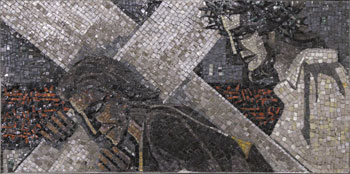
Large crowds were travelling with Jesus; and he turned and said to them, ‘Whoever comes to me and does not hate father and mother, wife and children, brothers and sisters, yes, and even life itself, cannot be my disciple. Whoever does not carry the cross and follow me cannot be my disciple. For which of you, intending to build a tower, does not first sit down and estimate the cost, to see whether he has enough to complete it? Otherwise, when he has laid a foundation and is not able to finish, all who see it will begin to ridicule him, saying, “This fellow began to build and was not able to finish.” Or what king, going out to wage war against another king, will not sit down first and consider whether he is able with ten thousand to oppose the one who comes against him with twenty thousand? If he cannot, then, while the other is still far away, he sends a delegation and asks for the terms of peace. So therefore, none of you can become my disciple if you do not give up all your possessions.’ NRSV
Post Communion Prayer
God of all mercy,
in this eucharist you have set aside our sins
and given us your healing:
grant that we who are made whole in Christ
may bring that healing to this broken world,God of all mercy,
in this eucharist you have set aside our sins
and given us your healing:
grant that we who are made whole in Christ
may bring that healing to this broken world,
in the name of Jesus Christ our Lord. in the name of Jesus Christ our Lord.
Commentary
The Old Testament reading lays before the Israelites the choice of life and prosperity or death and destruction. There were choices to be made and consequences to live by. The Israelites were asked to orientate their hearts to God and to live out the consequences of doing so, to love, walk, observe, live with God and to be blessed by Him as he led them on. Philemon has a choice to make too. Will he accept Onesimus back in the way Paul has asked? Does Philemon really believe that Paul, a prisoner with no real means of support apart from the gifts of others can repay what Onesimus might owe and ‘charge it’ to Paul’s account? How would we have received someone like Onesimus back? Would it be an, ‘Oh alright then…’ or something more gracious. In our acceptance would we have wanted Onesimus to feel a little bit guilty, accept him back but make him face up to the consequences of what he’d done? Perhaps feel a little smug in our, perhaps begrudging, acceptance of Onesimus back into the household, possibly feeling we’d been put in an impossible situation by Paul’s personal letter to us?
Choices to be made and consequences to live by. Early church commentators seem to indicate that Onesimus was indeed accepted back by Philemon and subsequently went on to be Bishop of Ephesus.
Jesus presents a choice to the ‘large crowds’ that are following Him. To give up all their possessions in order to become disciples of Jesus. He does so in the context of a story about building towers and a king waging war against another king, against whom he could never win. Jesus suggests that the king should seek peace with the more powerful force. It’s an interesting image, especially against the backdrop of Herod the Great who began to rebuild the Temple in Jerusalem to be both a dwelling place for God on earth and to be a symbol of legitimacy for Herod’s family claim to be kings of the Jews. It was about two thirds finished when Jesus was speaking. Was this the tower which was being built and for which the builder had underestimated what it would really cost to rebuild it and the king who had misunderstood that he would never win against forces far greater than he could ever muster?
Jesus heralds in a completely different Kingdom which has its own price it would seem, but not as the world views cost or price. Those who would follow Jesus would be on a track that would put them at odds with the Romans, for believing in another King and Kingdom other than Rome, at odds with their Jewish counterparts for going soft on their faith and nationalist ideals, and at odds with their families for putting something other than themselves as a priority in their lives. The idea of hating parents, brothers and sisters, spouses and children doesn’t so much mean a loathing for them, sometimes how this verse is misunderstood, but loving them a little less than Jesus and His call on their lives. Jesus is not speaking about the depth of love we should have for our families, often now as extended as they were in Jesus’ time, but about our priorities and choices.
One of the parallel readings for today is the passage from Jeremiah (Jer 18 v 1 – 11) where he goes down to the potter’s house and sees the potter working at his wheel. The pot the potter is shaping was marred so he took the clay and formed it into another pot. This is what God was doing through Jesus. It was the same clay, but a new pot was being formed. The creator was responding to the failure and the marred form of the first, just as God did in Jesus. He was not finished with the very stuff of His creation. Just as God had not finished with Onesimus it would seem, or with us. But just as there are choices to be made and consequences to live by, underlying the readings today is the message that rather than getting what might be expected the unexpected can happen. Paul does not appeal to Philemon’s sense of justice but to his understanding of love. An understanding that acknowledges we are all brothers and sisters in Christ, one in Him and equal in God’s sight.
When God sent His Son into the world, He did it because He ‘so loved the world that He sent His Son’. It was not out of any sense of justice, but of love for the world and His desire that His love should be revealed, if not through the Jews then through His Son in person. And now through us. We to then have choices to be made, priorities to set in our lives as we allow the master potter to shape the clay that is us into even better vessels and pots for His love.
Moses speaks to the Israelites in Deuteronomy as they were camped on the plain of Moab, about to enter into the Promised Land, somewhere far better than they had been, especially the last 40 years which they’d spent in the wilderness The Promised Land and the God’s Covenant with them are central themes in Deuteronomy as the people are urged to remember that they were slaves, remember God’s love for them, remember that it is to God that they owe their freedom and that through Him they will receive His blessings. But in order to do so they needed to keep the faith. To forget God would lead to darkness, despair and disaster. They had a choice to make. In the reading today, Moses’ life is drawing to a close and his parting words invite the commitment to make the right choice and to follow God. A few verses earlier he reminds them that God is ready to forgive and restore, even those who have forsaken Him. God will lead them on, not out of a sense of justice, but out of His love for them.
Paul does not ask Philemon to accept Onesimus because of any sense of justice but out of his love for him in Christ. Similarly, Jesus does not ask His followers to take up their cross and follow Him out of a sense of social, or any other kind, of justice, or because He’s on a mission against the Jewish authorities and Rome and He wants others to join Him on that quest. He invites them to follow Him because they love Him and want to join with Him in the mission of God for His world. A decision and choice to follow Him that will have consequences if it is to have meaning. Jesus knows, better than any other, that the decision to love God, and the choice to put Him first and at the centre of our lives and our very being will have eternal consequences. As we choose to love God through Jesus and reflect His love in the world that too has eternal consequences. Consequences not just for ourselves but for those who Jesus touches through us as He invites them to choose life too, so that they may truly live. Sam Cappleman
Meditation
In her book, ‘Fresh from the Word’, Rosalind Brown writes, [the Collect for the Prayer Book Fifteenth Sunday after Trinity (which is today and is included in our Prayers for Sunday and the Week Ahead) and our readings] …raises the question of with whom we are to be in fellowship. The answer in the Epistle is rather startling to people in a society with slavery as one of its building blocks. A slave owner was to be fervent in the fellowship of the gospel with one of his runaway slaves, who might also have defrauded him. Slavery first century style, while not something we would want to condone, was in some ways closer to mediaeval serfdom, with its duties and relentless hard work, than it was to kidnap and cruelty which was what was witnessed in the nineteenth century. Slaves could own property, and, for some, especially those with important masters, it was a way to make progress in the world. Paul speaks to one man in specifics: ‘I am appealing to you for my only child …have him back no longer as a slave but as a beloved brother.’ God’s generous mercy has transformed relationships. Paul’s subtle appeal to Philemon was to let his love for God trump his claim on his slave. Sam Cappleman
Hymns
- Tell his praise in song and story, Tune Abbots Leigh
- Who would true valour see
- Jesus, we have heard your Spirit Tune Ode to Joy
- I know not why God's wondrous grace
- I'll go in the strength of the Lord
- All my hope on God is founded.
- Give thanks with a grateful heart.
- As water to the thirsty.
- All praise to our redeeming Lord.
- Filled with the Spirit’s power with one accord.
Prayers for Sunday and the week ahead

"Prayer is a plant, the seed of which is sown in the heart of every Christian.
If it is well cultivated and nourished it will produce fruit, but if it is neglected, it will wither and die."
Holy Shaper of hearts and minds, as Jeremiah came to know you in the work of the potter’s hands, teach us your ways in the reading of your word. Lead us into a deeper understanding of your ways, that we may know and do your will. Amen.
God of our lives, you search us and know us. W have refused to take up your cross, to bear the burdens that are ours to carry. We have not given up our attachments to possessions or to self. We have not counted the cost of walking into an unknown future with you. Help us turn away from evil, that we may walk with you once more.
God of power and justice, like Jeremiah you weep over those who wander from you, turn aside to other gods, and enter into chaos and destruction. By your tears and through your mercy,
teach us your ways and write them on our hearts so that we may follow faithfully the path you show us. Amen.
Creator God, you form us on the wheel of life as a potter molds the clay. Shape us into holy vessels, bearing the mark of your wise crafting, that we may remain strong and useful through years of faithful and obedient service in Christ's name. Amen.
Additional Resources
Opening Verse of Scripture Psalm 139 :2
O LORD, you have searched me and you know me. You know when I sit and when I rise; you perceive my thoughts from afar. You discern my going out and my lying down; you are familiar with all my ways.
Collect Prayer for the Day - Before we read we pray
Almighty God, who called your Church to bear witness that you were in Christ reconciling the world to yourself: help us to proclaim the good news of your love, that all who hear it may be drawn to you; through him who was lifted up on the cross, and reigns with you in the unity of the Holy Spirit, one God, now and for ever.
Post Communion Prayer
God our creator, you feed your children with the manna, the living bread from heaven: let this holy food sustain us through our earthly pilgrimage until we come to that place where hunger and thirst are no more; through Jesus Christ our Lord.
Meditation
 St. Perpetua and Felicitas
In our Gospel reading today, Jesus speaks of being willing to take up the cross. The point that he was making was that following him could be costly, those who chose to do would encounter stiff opposition and they needed to be prepared to lose everything even their lives. The only apostle whose death the Bible records is James (Acts 12:2). King Herod had James “put to death with the sword,” likely a reference to beheading. The circumstances of the deaths of the other apostles are only related through church traditions. The most commonly accepted church tradition in regard to the death of an apostle is that the apostle Peter was crucified upside-down on an x-shaped cross in Rome. However we do have many accounts of the deaths of Christian martyrs, those who were prepared to die for their faith and many who literally took up thier own cross.
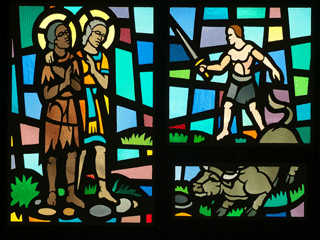
St. Perpetua was a noble woman of Carthage and St. Felicitas her slave in the year 203. The two women were arrested for confessing Christianity and refusing to offer sacrifices to the Roman gods. At the time, the Emperor Severus was persecuting Christians. Felicitas was pregnant at the time of her arrest and gave birth only three days before her executing. Both were beheaded by a gladiator after being gored by a bull in a public arena in the North Attain city which is today’s Tunis. Moments before they were killed, the two pleaded with fellow Christians to cling to the faith and for others to adopt the faith and accept suffering as the price of salvation. It is said St. Perpetua had to guide the sword of the gladiator to her throat because he was nervous and could not strike in the right place.
Commentary
On the noticeboard outside a church a minister took off his name and put ‘everybody.’ Now that doesn’t help when you want to arrange a wedding, but the point which was being made was that the ministers are not just the ones with dog collars, everybody is involved. In our baptism we are called ‘soldiers’ and ‘servants’ of Christ. Jesus in the passage from Luke today is trying to make this important point.
'If anyone comes to me and does not hate his father and mother, his wife and children, his brothers and sisters--yes, even his own life--he cannot be my disciple. And anyone who does not carry his cross and follow me cannot be my disciple'
There is something lost in the translation when we read the word hate, 'loves less' would be better than 'hate' but nevertheless we are used to Jesus using strong language to make forceful points. Jesus uses hyperbole to express literal truth, and he says things such as ‘if a part of your body cause you to sin then cut it off’. We know he wouldn't want people to go around self harming but he did want his words to have effect when serious points were being made about the need for authentic Christian living. Using dramatic language for effect was a tool of his trade. The word hate teaches us that we have to be wholehearted as Christians.
When an over zealous follower promised to follow Jesus wherever he went, Jesus made it clear that he had no idea what he was saying. Jesus warned another follower about going off to a family funeral. The disciples who let Jesus down so badly could at least say that they had understood this level of commitment by telling Jesus ’ Lord, we have left all to follow you.’ Remember Andrew, Peter, James and John, who when they were called left the family business, or Matthew who had a good job at the tax office and ‘got up and left everything to follow him.’
There is a very important point which Jesus is making. Where you are born, where you come from, your family, your background, your occupation, these things do not define you. What defines you is your place before God. So Jesus wants his disciples to be committed in their faith. When the Bible uses words like ‘soldier’ to describe the Christian, or ‘athlete’, then the message which is being made is that Christianity is not a spectator sport. You are meant to be involved a participant, committed not complacent.
Jesus was disturbed by the number of people who followed him and yet he wasn't into the numbers game, he almost tried to put them off ! Jesus told the parable of a man who built a house but he never calculated properly what was involved and he ran out of money and materials. He made a fool, of himself because he started something which he couldn't finish. Jesus wanted a whole life of commitment, not a half hearted, partial commitment.
The symbols of the Christian faith are a cross, the bread broken for us, the blood poured out for us.
The commitment of Jesus was absolute and he calls the follower to dedication. The follower must therefore ask themselves whether they have the stomach for such a commitment.
We are conditioned to think that sacrifice is a bad thing but actually it is not. Some of the greatest
achievements require huge sacrifices. We all know about the commitment made by our Olympic GB team who told of years of brutal training before they achieved a medal. We all know parents who make huge sacrifices so that their children can have good education or to provide a home and the best start in life. Students sometimes have to go through years of hard study before they can become qualified in their profession. Sacrifices might not be easy or even enjoyable but they do give our lives purpose and can be very rewarding in a way that our instant gratification, immediate access culture sometimes fails to provide.
In the same way Jesus is not asking for toil and tribulation without reason. Rather Jesus is holding out the promise of huge reward and abundant life giving fulfilment, but only for those who are willing to give themselves into the commitment required.
This honesty from Jesus is very refreshing in a world where people make huge promises and we are so often sold something on the cheap. All around we are told that we only have to do this, or buy that and our lives will be fulfilled. We are promised that if only we vote a certain way, or join a particular group or programme that our lives and even the world can be transformed. Jesus tells us that we must not start what we cannot finish, his journey is to Jerusalem and that means death.
Schools are being criticised in their Ofsted reports recently. They might be OK schools but they are not doing as well as they could and should be doing and so they are said to be 'coasting.' Jesus is making the same kind of judgement on his followers and telling them that it is no good just thinking that we are OK. He calls us to a living daily commitment but promises that earthly pain brings heavenly gain. Charles Royden
Commentary
The sayings of Jesus are difficult enough without having to contend with the differences in time and culture. Today is one of those occasions where the teaching of Jesus is challenging and we also have some cultural differences to make sense of. Even those with a modest appreciation of the teaching of Jesus will be aware that he was not the sort of teacher to instruct his followers to hate anybody, and to encourage hatred of your own family would be unthinkable. So what did he really mean?
This week I saw a film from Syria, recorded probably on a mobile phone. It showed a scene in which some Sunni militia had stopped lorries being driven by civilian Alawites. They are all Muslim but from very different sects. When questioned the lorry drivers pretended to be Sunni as well. The militia waved their guns and asked questions about their religious behaviour, such as how many times they prayed in the morning. The Alawites never gave the correct answers and their lack of knowledge betrayed them. They were made to kneel and then shot, their crime to be from the wrong tribe, the wrong family. Put into this context we can begin to see how strong the ties of family and tribe would have been and still are in the Mediterranean world where Jesus taught. The family gave the person their identity and before anybody thought about turning to follow Jesus they would need to understand the consequences which discipleship would bring. This is really difficult and people needed to understand what they were doing before jumping in feet first to follow Jesus. Were they willing to risk rejection and perhaps death as the consequence of following Jesus? If all of this sounds dramatic then we need only think of the hatred and bitterness which divide countries such as Syria, where even those who share basic principles of faith have hugely differing loyalties. Jesus often used hyperbole, he spoke in extremes to get his point across, telling people to chop off parts of their body that caused them to sin might be an example. Sometimes we explain that this is what Jesus is doing here and really a better translation might be ’love less than me’ rather than hate. However there is real cost to discipleship and turning to Jesus would often mean that blood ties were broken, the person would be cut off from their family.
Jesus doesn’t want half hearted followers, but neither does he want people to follow him who are unprepared for the journey. Someone said to Jesus "I will be your follower wherever you go" (9:57). They were clearly full of enthusiasm but Jesus pours cold water on their excitement with a stark reminder, "the foxes have lairs, the birds of the sky have nests but the Son of Man has nowhere to lay his head" (9:58). The costs of discipleship might mean detachment from one’s previous world and way of living, it might mean hardship, loss of home and family and ultimately a cross.
The warning of Jesus are clear, 1. Anyone who puts close relationships before Jesus is "not able to be" his disciple. 2. Anyone who does not bear their cross is "not able." 3. Anyone who does not forsake "all that he has" is "not able." All of this sounds fairly depressing but there is a positive side ! Jesus is clear that where one comes from lies firmly in the past, we are not victims of the past and it no longer defines who we are. Where we are born, our class, who our daddy is, none of this is of any importance to Jesus. This is in the past and when a follower turns to Jesus it is like they are born again, into a new family. Charles Royden
Commentary
I suppose I have to admit that when looking at the Bible readings Sunday by Sunday and deciding which passage to preach about, I usually go for the Gospel reading. It seems so much more appropriate to go straight for the teachings of Jesus, why bother with somebody like Paul when you can go direct to the words of the one we believe was God's presence here on earth. Surely it is for this reason that we stand for the Gospel reading at our services of Holy Communion, for we are about to hear as directly as possible the authentic words of God to us from the mouth of Jesus. Yet when looking at the passage today it might be easier to avoid the Gospel reading. How can Jesus tell us that we must hate our families if we wish to be real disciples? What does he really mean?
We know that Jesus was a fine preacher, every where he went people followed him, he was a celebrity, and in an age without television and our media, he used the platforms which were available to him to get his message across, particularly public speaking. He would sit in boats and on mountains to address crowds, he would perform miracles to attract attention and get his message across. We know that he also used powerful preaching images and hyperbole or exageration ! For example, he said that if parts of our body caused us to sin we should cut them off. Jesus really didn't, I am sure, want people who told lies to cut their tongues out, but the point was made very clearly that he was seeking disciples who took the whole thing seriously. Jesus attracted thousands of people to come and hear him but he wasn't in the numbers game. He wanted a certain quality of disciple, he did not want a huge quantity of hangers on who wanted to be associated with his celebrity, or who were in for what they could get out.
Jesus frequently impressed upon his followers that whilst it might seem exciting to be one of his disciples, making that decision was not an easy choice. Anybody who followed Jesus because they thought that
it was a passport to success was in for a shock. If a person chose discipleship it would not mean increased wealth, Jesus made this point by telling some folks to give all they had away. Jesus lived a lifestyle that was meant to make the point, he had no wealth or possessions to speak of, he had no home of his own. Jesus was on a mission, it was a collision course with government, church, all the structures of authority and he had to be sure that those who followed him had deeply considered the consequences and knew it was not going to be an easy ride.
His disciples would be engaged in a revolution of power and a call for an uprising against all of the spiritual values which most people believed had been given directly by God to a chosen people. Jesus knew that this would be a bloody and bitter conflict and he did not want his followers to be so attracted by him that they failed to understand the torment which lay ahead. The path which Jesus had chosen was not dangerous, if we speak of something being dangerous then there is the expectation that we might survive.
Jesus had not chosen to walk a dangerous path, rather he had chosen to walk into death itself. The way ahead led into true life, but this would only take place through encountering the dark forces which opposed him, there would be no way out. How could he make this message to his followers more clear than by telling them that they must take up their cross. The cross was an instrument of death, this was the structure upon which executions took place. Jesus knew that if anybody followed him they were effectively giving up their lives. His words to his followers were therefore carefully chosen, nobody should follow who needed to look after children, family or parents. Once they had signed up to follow Jesus, his followers must look resolutely towards Jerusalem where an almighty battle with the forces of power would lead to imprisonment and crucifixion. This was a suicide mission, not in the cruel sense of giving your life to take the lives of others, rather as a martyr, willing to lay down one’s own life in commitment to the cause.
The message today is not about whether we have to hate our mothers, we know for a fact that one of the things which Jesus did on the cross was to demonstrate his love for his own mother. Rather the message is about making sure that we take seriously what discipleship involves. This is the purpose of the parables which Jesus tells. Before he starts to build, a builder must work out how much the finished building will cost, and can it be afforded. Any builder who starts laying bricks without working out the finished building might be severely embarrassed if they don't have the means to get the project finished. The worst thing about it is that the half finished structure will be there as a constant reminder, a monument of his stupidity in starting something which he hadn't thought about properly.
The other parable told is the story of a king who goes to war, but doesn't think about how the war will end. Why would you go to war against an enemy unless you could be sure that there was a way of eventually bringing about a successful conclusion? Today we would say it was stupid to go to war unless you had a realistic expectation of peace and an exit strategy. If we do not have these things then we risk being accused of having other motives, or the suggestion that we just got angry and lashed out without considering the final consequences. The message is clear a sensible leader if they knew that the objectives could not be settled by military means, would embark more sensibly upon a process of negotiation.
So if we want to be followers of Jesus, if we want to start a journey of discipleship, then be realistic about what it entails. It is not about finding peace, it is not about being spiritually fulfilled, it is not about receiving blessings from God. Followers of Jesus will be expected to challenge wrongs, to work for justice and put the needs of others before themselves. God’s way is difficult and costly and following this way of discipleship may lead us on a journey which might be demand much from us. Charles Royden
Commentary
Hate my family? Does Jesus really expect his followers to hate those they love the most? Clearly none of us is going to go home and start hating our family for no reason. We might read the words of Jesus and say that they are not meant to be taken literally, after all Jesus does sometimes use really strong words to make a point. He once said to chop bits off our body that cause us to sin, he never meant that literally either. But be careful. All of the above might be true, but the fact is that Jesus wanted to make a really serious point, that was why he used strong words to shock and bring attention to certain parts of his message. There is a powerful message here today which Jesus is making and we need to take it equally seriously.
I remember in the late 1960’s and early 1970’s it was hard being a Liverpool supporter. Liverpool endured seven years in which they never won a cup. Things got better of course, they won the UEFA Cup in 1972/73, followed by the FA Cup again in 1973/74. But during those dark days only the true supporters stood by their team. The weaker and less committed fans fell by the wayside and some even turned to follow the false promises of team like Everton. Strange but true.
We know with the benefit of hindsight that when Jesus spoke these words he was on his way to Jerusalem and certain death. But equally we also know that nobody expected him to go through with such a suicidal mission. The moral of this story is simple. People like winners and they like to back the favourite, hoping to be able to bask in reflected glory. The disciples and those who followed him saw miracles and a man who appeared in control. Jesus could argue his point with the finest religious minds and he was not afraid of anything or anyone visible or invisible. It must have been tempting to tag along with Jesus knowing that he was a real winner, the favourite.
Jesus will have none of this easy going, pick a winner discipleship. He is on his way to Jerusalem and a cross, not the crown which the crowd thinks he will achieve. They consider Jesus a "winner," and follow him so that they might win too. Jesus teaches them that discipleship carries a high price tag. Those who aspire to follow Jesus need to count the cost before signing on the dotted line. Jesus demands commitment, an unpopular word these days. As we read the passage from Luke this morning we are challenged to be disciples who are willing to walk with him through good times and bad. Jesus never tries to disguise the cost of discipleship, God demands first place in our lives and those with real commitment are willing to pay the price. Charles Royden
Commentary
The letter in the New Testament, entitled ‘Philemon’ was
written by Paul, whilst in prison in Rome in about AD 60 – 62, to his good
friend Philemon and his friends who met as a church in Philemon’s home. It
is one of Paul’s shortest letters recorded in the Bible, being just one
chapter and only twenty five verses. None the less there is much depth in
this letter, as there is in all of Paul’s letters. As has been said in the
past, in many ways we learn as much about what it is to be a Christian from
Paul’s letters as we do from what is recorded of Jesus’ words and actions.
Philemon, we can assume, was converted to Christianity by Paul and has
become a fellow worker with Paul and others for Christ. Through this
conversion they have developed a deep and loving relationship based on their
common bond in Christ. It is because of their close bond that Paul can write
as he does to Philemon pleading with him to give Onesimus a warm welcome
when Paul sends Onesimus back to him.
Onesimus, whose name means useful or profitable, appears to have stolen
something from Philemon when he was his slave and then escaped from slavery
and turned to Christ. Not surprising then that Paul, who has a big favour to
ask, is very careful how he words his letter to his friend. How would we
respond if we were asked to accept someone back into our household who had
stolen from us? Paul begins by emphasising how pleased he is with Philemon’s
life of faith and what joy that has brought Paul. He then makes his appeal
‘confident of Philemon’s obedience’ (v 21). Confident of his obedience, not
to Paul, but to God.
Paul himself is acting out of obedience to God in returning Onesimus to
Philemon. He would much rather keep Onesimus with him as he regards him as a
son and to help him while he is in prison. It was a wrench that he was
prepared to bear for the sake of the Gospel. Onesimus, who Philemon might
regard as a useless slave, will become useful to him not as a slave but as a
‘brother in the Lord’. Through entreating his friend, rather than ordering
him, to accept Onesimus back Paul reflects how God calls us to obedience to
his wishes.
Paul makes no judgement here on the practise of slavery, the ending of which
is being commemorated this year. Rather he demonstrates what a
transformation from slave to fellow worker there can be if all those
concerned are in a loving relationship with our Lord from which flows a
desire to act as he would have us act. Perhaps though this letter might just
nudge us to reflect on how we treat today’s ‘slave’s’; workers abroad who
are paid a pittance, child workers, those entrapped by poverty and
exploitation into prostitution, and even women and children locked up on our
doorstep in Yarlswood. Wendy Waters
Commentary
Whilst preachers concern themselves with love and 'holiness' they are seldom likely to offend. However when they start to work out the implication of what this means in terms of daily living there is going to be a riot. Jesus was prepared to speak his mind about what real love for God and holiness entailed and there are unpleasant side effects. The charismatic Jesus is now prepared to say that the consequences of following him were going to be sacrifices of friendships and yes, even families. The passage today is one of those really difficult ones, harsh in its radical edge. Following Jesus demanded people who were out of the ordinary, it was not a 'soft option,' it was hard work.
In the passage today there are difficult words for everybody 'if you don't hate father and mother, wife and children, brothers and sisters yes, even life itself you can't be my disciple.' The word hate doesn't sound right on the lips of Jesus, indeed it is contrary to the teaching of Jesus himself to love. It offends against the values which most people hold dear. Worse than that, it offends against the love commandment by enjoining hate. What was Jesus up to? It is shocking and doubtless intended to be shocking. So why does Jesus use words which are such dynamite? What could possibly justify, or require, such a blast? Clearly the assumption is that the object to be dislodged will take some moving. That object is family power. Families can imprison people from the very womb, instead of being safe places to grow and develop and realise our full potential, the family can just as easily become a cage a prison of power and control. Families can pass on to us the deepest prejudices and distorted ideas about ourselves and others, it takes a great deal of intellectual strength to challenge those assumptions which have been passed on from one generation to another in the sacred institution. It is sometimes assumed that Christianity automatically considers families to be marvellous, Jesus makes it clear that they are not. Families are not sacred or necessarily safe, they can do great damage and we must be aware and question all of the influences which affect us. Alternatively, but equally dangerous, the family can also be a comfortable escape, a secure place in which to turn aside from one's potential and the world's challenge.
So Jesus uses harsh words like 'hate,' and we find it hard to listen. What are we to make of it? When Jesus said that we must cut parts of our body off if they have cause to offend, he was not speaking literally. He was using language to make a very clear point. So too in this episode we will miss the point if we think too long about hating our families. But such shocking rhetoric recognises that families can devour us like wolves. Jesus understands that families can constrict growth, become oppressive demons, and bring death rather than life. According to Mark, Jesus' own (family) thought he was mad and sought in their terms to rescue him (3:20-21, 31-35). They would have been much happier if he had built his dreams on being a clever carpenter 'Jesus the Joiner,' he was speaking form personal experience.
This is not a call to fanaticism akin to that seen in groups which attract young people away from their families, but there is a challenge for each of us to be prepared to stand up for our faith and Christian principles, to be counted and face the consequences. There may be times this week when we have to do just that, even with our own families . Charles Royden
Meditation
A politics concerned with immediate results, supported by consumerist sectors of the population, is driven to produce short-term growth. In response to electoral interests, governments are reluctant to upset the public with measures which could affect the level of consumption or create risks for foreign investment. The myopia of power politics delays the inclusion of a far-sighted environmental agenda within the overall agenda of governments. Thus we forget that “time is greater than space”, that we are always more effective when we generate processes rather than holding on to positions of power. True statecraft is manifest when, in difficult times, we uphold high principles and think of the long-term common good. Political powers do not find it easy to assume this duty in the work of nation-building. (178) Laudato Si, Pope Francis
Jesus calls his disciples to choose the right path but this was not an easy choice then and neither is it today. Our leaders are surrounded by voters who are fickle and want them to speak what they want hear. Our newspapers sell when they headline with disgusting intrusions into people’s lives not when they accurately report important news. When businesses charge what is needed to properly reward labour, not exploit the planet and ethically source materials we buy cheap goods from dubious sources. If we commit ourselves to being people who do the right thing then we will enjoy the benefits individually and as a society and we will walk God’s pathway in our daily lives, but if we fail to do this then there is also a cost for us and for our world.
Meditation
Becoming a Christian requires repentance, a word that in the Greek means more than sorrow for sin; the picture is a soldier doing an about-face – turning to face a new direction. Jesus makes it clear that becoming a Christian means a turning toward God and a turning away from concern for possessions.
Meditation
Poverty, Chastity, Obedience, these are the vows that many called to
a way of life that might commonly be called ‘holy orders’ are required
to take. Today that calling may range from living in an enclosed
community to living in and serving the wider community, but nevertheless
those ‘called’ always live by a ‘rule’ usually requiring them to take on
these three commitments. For many the call to obedience might be the
most challenging. Not surprising when there is so much emphasis in
society on the rights of the individual. ‘My will not yours’ is more
commonly expressed in words and deeds than perhaps those of Jesus’ ‘Your
will not mine’. Only a slight change in word order brings about a
massive change in ‘world order’.
As children begin to explore their own identity they begin to express
their will by screaming and refusing to do as they are told by those
responsible for them. This is often referred to as ‘the terrible two’s’.
As they grow and develop through the different ages and stages of life
young people will find other ways to express ‘their will', including
through clothing, hairstyles, music and perhaps body piercing. Through
these stages they too may struggle with being obedient. How the adults
responsible for them respond to this resistance will greatly influence
how they eventually develop and mature as adults.
Learning to be obedient is common to us all whether we are children,
young people, adults, Christians in the community or those in ‘holy
orders’. What may not be common is what we think obedience means. The
Latin derivation of the word’ obedience’ suggests that to equate it with
slavish submission or the misuse of power is a mistake. It is not about
compliance, power wielded by one over another. Neither can it be assumed
to be automatic. Rather it is rooted in listening, an act which is
rooted in listening, can only take place in a relationship. It is as we
grow into a deeper relationship with our loving God and listen to Him
that we will learn that true obedience free us not enslaves us. Wendy Waters
Prayer
Glory to you, O Champion of all Loves, who for our sake endured the cross, encountered the enemy and tasted death. Glory be to you, O King of all Kings, who for our salvation wrestled with principalities and powers, subdued the forces of hell and won the greatest of all victories. To you be all praise, all glory and all love; now and for ever. Amen. Thomas Ken, 1637-1711
Father, all loving and most tender, we confess the hardness of our hearts and our want of compassion for our neighbour. Grant us the grace of pity, the ministry of compassion and the gift of consoling the broken-hearted. Teach us to love with your own forbearance and never harshly or unlovingly to judge another; for your own mercies' sake. Amen Johann Arndt, 1555-1621
O most gracious Redeemer and King, come and dwell within us and reign where
you have the right to reign. By your Holy Spirit take possession of our
souls and lead us in the ways of righteousness and peace; through Christ our
Lord. Amen John of Kronstadt, 1829-1908
Lord God you came as a neighbour to humankind in Jesus. Give us eyes to see
you in other people and make us instruments of your care to all., that
everyone may become true neighbours in Jesus Christ our Lord. Amen.
O God, whose glory the heavens are telling, the earth your power, the sea
your might, and whose greatness all the hosts of heaven proclaim; to you
belongs all glory, honour, majesty and praise; both now and for ever, and to
the ages of ages Amen. Liturgy of James, 5th century
Living God, inform and inspire the way we look at your world, that we may
see strangers and notice in them the potential for friendship; that we may
see people of faith, observing how we can work together; that we may see
fellow Christians, and with them reveal the marks of service; that we may
see ourselves, with all our imperfections, as loved by you; that, looking to
Christ, we may see with the eyes of his love. Amen. Heather Noel-Smith.
To my weariness, O Lord, grant your rest; to my exhaustion, your strength and to my tired eyes, your healing light. Guide me, guard me and shelter me within the shadow of your wings and quicken me in your service with the brightness of your glory; through Jesus Christ our Lord. Amen. Lancelot Andrewes, 1555-1626
Hymns
- O worship the Lord
- If any man will follow
- Knowing you Jesus
- Will you come and follow me
- I cannot tell
- Lord the light of your love is shining
- O Jesus I have promised
- Abba Father
- I want to walk with Jesus Christ
- Lord of creation
- Tell out my soul (Tune Woodlands)
- This little light of mine
- Be still for the presence of the Lord
- The Lord is king lift up thy voice (Tune Church Triumphant)
- And can it be (Tune Sagina)
- Christ is surely coming (Tune Marching through Georgia)
- Tell his praise in song and story, Tune Abbots Leigh
- Who would true valour see
- Jesus, we have heard your Spirit Tune Ode to Joy
- I know not why God's wondrous grace
- I'll go in the strength of the Lord,
Sermon (The cost of discipleship)
Tell his praise in song and story,
bless the Lord with heart and voice;
in my God is all my glory,
come before him and rejoice.
Join to praise his Name together,
he who hears his people's cry;
tell his praise, come wind or weather,
shining faces lifted high.
To the Lord whose love has found them
cry the poor in their distress;
swift his angels camped around them
prove him sure to save and bless.
God it is who hears our crying
though the spark of faith be dim;
taste and see! beyond denying
blest are those who trust in him.
Taste and see! In faith draw near him,
trust the Lord with all your powers;
seek and serve him, love and fear him,
life and all its joys are ours:
true delight in holy living,
peace and plenty, length of days;
come, my children, with thanksgiving
bless the Lord in songs of praise.
In our need he walks beside us,
ears alert to every cry;
watchful eyes to guard and guide us,
love that whispers 'It is I.'
Good shall triumph, wrong be righted,
God has pledged his promised word;
so with ransomed saints united
join to praise our living Lord!
Tune Abbots Leigh
1 Who would true valour see,
let him come hither;
one here will constant be,
come wind, come weather;
there's no discouragement
shall make him once relent
his first avowed intent
to be a pilgrim.
2 Whoso beset him round
with dismal stories,
do but themselves confound;
his strength the more is,
No lion can him fright;
he'll with a giant fight,
but he will have a right
to be a pilgrim.
3 Hobgoblin nor foul fiend
can daunt his spirit;
he knows he at the end
shall life inherit.
Then, fancies, fly away;
he'll not fear what men say;
he'll labour night and day
to be a pilgrim.
1 Jesus, we have heard your Spirit
saying we belong to you,
showing us our need for mercy,
focusing our hopes anew;
you have won our hearts' devotion,
now we feel your guiding hand:
where you lead us, we will follow
on the paths your love has planned.
2 As a chosen, pilgrim people
we are learning day by day
what it means to be disciples,
to believe and to obey.
Word and table show your purpose;
hearts and lives we gladly bring-
where you lead us, we will follow,
suffering Saviour, risen King.
3 How we yearn that every people
should exalt your matchless name,
yet so often this world's systems
countermand your regal claim.
If we stand for truth and justice
we, like you, may suffer loss;
where you lead us, we will follow-
give us grace to bear our cross.
4 So we journey on together,
keen to make our calling sure:
through our joys, our fears, our crises,
may our faith be made mature.
Jesus, hope of hearts and nations,
sovereign Lord of time and space,
where you lead us, we will follow
till we see you face to face.
Tune Ode to Joy
1 I know not why God's wondrous grace
to me has been made known;
not why - unworthy as I am -
he claimed me for his own.
But 'I know whom I have believed;
and am persuaded that he is able
to keep that which I've committed
unto him against that day.'
2 I know not how this saving faith
to me he did impart;
nor how believing in his word
wrought peace within my heart.
3 I know not how the Spirit moves,
convincing men of Sin;
revealing Jesus through the word,
creating faith in him.
4 I know not what of good or ill
may be reserved for me -
of weary ways or golden days
before his face I see.
5 I know not when my Lord may come,
at night or noonday fair,
nor if I'll walk the vale with him,
or 'meet him in the air.'
1 I'll go in the strength of the Lord,
In paths he has marked for my feet;
I'll follow the light of his word,
Nor shrink from the dangers I meet.
His presence my steps shall attend,
His fulness my wants shall supply;
On him, till my journey shall end,
My unwavering faith shall rely.
I'll go (I'll go) I'll go in the strength.
I'll go in the strength of the Lord,
I'll go (I'll go) I'll go in the strength.
I'll go in the strength of the Lord.
2 I'll go in the strength of the Lord
To work he appoints me to do;
In joy which his smile doth afford
My soul shall her vigour renew.
His wisdom shall guard me from harm,
His power my sufficiency prove;
I'll trust his omnipotent arm,
And prove his unchangeable love.
Chorus
3 I'll go in the strength of the Lord
To conflicts which faith will require,
His grace as my shield and reward,
My courage and zeal shall inspire.
Since he gives the word of command,
To meet and encounter the foe,
With his sword of truth in my hand,
To suffer and triumph I'll go.