
Worship resources, prayer and bible study
Second Sunday of Advent
Liturgical Colour - Purple
| Opening Verse |
|
Advent 2People of God: |
| Collect Prayer | ||
| First Reading: | ||
| Second Reading: | ||
| Gospel Reading | ||
| Post Communion Sentence | ||
| Commentary: | ||
| Meditation: | ||
| Hymns | ||
| Prayers for Sunday and the week ahead: | ||
| Intercessions from our Sunday worship | ||
| Sermons |
Introduction
It was really funny in church last Sunday for the First Sunday of Advent family service talk. The Minister was talking about Advent and the coming of Jesus and he asked the children what we do when we have friends comeing to stay in our house. Quick as a flash one of our bright your minds said 'put on a brave face'. I am sure that she was absolutely right, but as well as puttign on a brave face we also have to make lots of things right. Fresh linen, clean the house make, sure we have things looking nice for when they arrive. Somebody once remarked that wherever the Queen goes she must get fed up with the smell of fresh paint. The point being made is that when she visits everybody takes time to make sure that everything is at its best. Walls are repainted, new floors laid in some instances even new roads are laid. We instinctively know that if we do not try our best and make everything right we are letting ourselves down as well as being disrespectful to our guest. It is exactly the same when we have guests coming to stay in our home, it would be a poor show if we failed to clean the place and make sure everything was tidy.
It is this message of making ready which john The Baptist proclaims in the reading from Mark's Gospel today. Jesus is coming, he is of very special importance and we need to make sure our lives are suitable to accommodate his presence. Clear out the rubbish, if we want God to dwell within us then we have to prepare a holy place and make our hearts fit accommodation. It might not be that we are dreadful people, but the sins of good people are sometimes the worst ones because of that smug veneer of goodness. Making our lives ready is more than the absence of horrendous sins, it is the presence of generosity, absence of the preoccupation with self.
Now is a good time to ask ourselves the question -' what good things make my life special '
Advent is short this year, indeed only three full weeks, because Christmas Eve is on a Sunday. The fourth week is really only a few hours long! Jesus is coming, and there is not much time
to prepare, but worry not. Advent is a reminder not a deadline. Our lives should be lived with the Advent sense of expectation to make ourselves the place where Christ will dwell comfortably with us.
Opening Verses of Scripture Mark 1:2,3
It is written in Isaiah the prophet: "I will send my messenger ahead of you, who will prepare your way"-- "a voice of one calling in the desert, 'Prepare the way for the Lord, make straight paths for him.'"
Psalm 85 v 8 - 10
I will listen to what God the LORD will say; he promises peace to his
people, his saints— but let them not return to folly. Surely his salvation
is near those who fear him, that his glory may dwell in our land. Love and
faithfulness meet together; righteousness and peace kiss each other.
Collect Prayer for the Day — Before we read we pray
O Lord, raise up, we pray, your power and come among us, and with great might succour us; that whereas, through our sins and wickedness we are grievously hindered in running the race that is set before us, your bountiful grace and mercy may speedily help and deliver us; through Jesus Christ your Son our Lord, to whom with you and the Holy Spirit, be honour and glory, now and for ever. CW
Almighty God, purify our hearts and minds, that when your Son Jesus Christ comes again as judge and saviour we may be ready to receive him, who is our Lord and our God. CW
First Bible Reading Isaiah 40: 1-11
Comfort, O comfort my people, says your God. Speak tenderly to Jerusalem, and cry to her that she has served her term, that her penalty is paid, that she has received from the LORD’s hand double for all her sins. A voice cries out: ‘In the wilderness prepare the way of the LORD, make straight in the desert a highway for our God. Every valley shall be lifted up, and every mountain and hill be made low; the uneven ground shall become level, and the rough places a plain. Then the glory of the LORD shall be revealed, and all people shall see it together, for the mouth of the LORD has spoken.’A voice says, ‘Cry out!’ And I said, ‘What shall I cry?’ All people are grass, their constancy is like the flower of the field. The grass withers, the flower fades, when the breath of the LORD blows upon it; surely the people are grass. The grass withers, the flower fades; but the word of our God will stand for ever. Get you up to a high mountain, O Zion, herald of good tidings; lift up your voice with strength, O Jerusalem, herald of good tidings, lift it up, do not fear; say to the cities of Judah, ‘Here is your God!’ See, the Lord GOD comes with might, and his arm rules for him; his reward is with him, and his recompense before him. He will feed his flock like a shepherd; he will gather the lambs in his arms, and carry them in his bosom, and gently lead the mother sheep. NRSV
Second Reading 2 Peter 3:8-15a
Do not ignore this one fact, beloved, that with the Lord one day is like a thousand years, and a thousand years are like one day. The Lord is not slow about his promise, as some think of slowness, but is patient with you, not wanting any to perish, but all to come to repentance. But the day of the Lord will come like a thief, and then the heavens will pass away with a loud noise, and the elements will be dissolved with fire, and the earth and everything that is done on it will be disclosed. Since all these things are to be dissolved in this way, what sort of persons ought you to be in leading lives of holiness and godliness, waiting for and hastening the coming of the day of God, because of which the heavens will be set ablaze and dissolved, and the elements will melt with fire? But, in accordance with his promise, we wait for new heavens and a new earth, where righteousness is at home. Therefore, beloved, while you are waiting for these things, strive to be found by him at peace, without spot or blemish; 15and regard the patience of our Lord as salvation. NRSV
Gospel Reading Mark 1: 1-8
The beginning of the good news of Jesus Christ, the Son of God. As it is written in the prophet Isaiah, ‘See, I am sending my messenger ahead of you, who will prepare your way; the voice of one crying out in the wilderness: “Prepare the way of the Lord, make his paths straight”’, John the baptizer appeared in the wilderness, proclaiming a baptism of repentance for the forgiveness of sins. And people from the whole Judean countryside and all the people of Jerusalem were going out to him, and were baptized by him in the river Jordan, confessing their sins. Now John was clothed with camel’s hair, with a leather belt around his waist, and he ate locusts and wild honey. He proclaimed, ‘The one who is more powerful than I is coming after me; I am not worthy to stoop down and untie the thong of his sandals. I have baptized you with water; but he will baptize you with the Holy Spirit.’ NRSV
Post Communion Sentence
Father in heaven, who sent your Son to redeem the world and will send him again to be our judge: give us grace so to imitate him in the humility and purity of his first coming that, when he comes again, we may be ready to greet him with joyful love and firm faith; through Jesus Christ our Lord. CW
Commentary
Commentary Advent – He Comes!
Advent is a season of expectation and preparation, as the Church waits
for the coming (adventus) of Christ, both in his incarnation and as judge at
the end of time. The readings and liturgies therefore look forward not only
to Christ’s birth, but also to his final Coming, and challenge the modern
reluctance to confront the theme of divine judgement: As Charles Wesley
wrote:
Every eye shall now
behold him
robed in dreadful majesty
The characteristic note of Advent is expectation, rather than penitence, although the character of the season is easily coloured by an analogy with Lent. The anticipation of Christmas under relentless commercial pressure has also made it harder to sustain the appropriate sense of alert watchfulness. Church decorations are simple and spare, and purple is the traditional liturgical colour. In the northern hemisphere, the Advent season falls at the darkest time of the year, and the natural symbols of darkness and light are powerfully at work throughout Advent and Christmas.
The lighting of candles on an Advent wreath was imported into Britain from
northern Europe in the nineteenth century, and is now a common practice. The
Moravian custom of the Christingle has similarly enjoyed great success in
Britain from the late twentieth century, with the encouragement of the
Children’s Society; Christingle services may take place before or after
Christmas. The third Sunday of Advent was observed in mediaeval times as a
splash of colour in the restrained atmosphere of Advent (Gaudete or “Rose
Sunday”), and the last days of Advent were marked by the sequence of Great
‘O’ Antiphons, which continue to inspire modern Advent hymns and
meditations. From Common Worship – Introduction to the Season
A sense of urgency
Mark's Gospel begins not with Jesus, but with John the Baptist.
Immediately the writer quotes from Isaiah 40, transferring the reference to
Israel's return from exile in Babylon to the coming of the Messiah clearly
intending that John the Baptist be seen as the prophet who prepared the way
for Jesus, the Christ/Messiah. The early church searched the Hebrew
scriptures for every possible prophecy about the coming of Israel's Messiah,
no matter whether they were relevant or not. They understood the coming of
Jesus Christ, the Son of God, into the world as the fulfilment of those
prophecies. Now that God's love and purpose for Israel are being fulfilled,
John calls everyone to prepare by repenting and being baptised.
And yet, there is a stark contrast between the tone of Isaiah and Mark. In
Mark, John the Baptist speaks urgently and harshly. Not exactly the ‘speak
tenderly to my people’ Hosea perhaps had in mind. Isaiah’s words of gentle
encouragement are replaced with words of urgency and immediacy. In Mark,
John implores us to action.
John also speaks to us in a desert context. A lonely dry wilderness. A
geographic location and a spiritual state. John speaks to us with urgency
from his desert experiences into ours. And the people, listening to John,
were drawn not to him, but to the one he pointed to, the one who would give
living water, the one who would baptize with the Holy Spirit. As Christians
we will sometimes find ourselves in the desert places, where our spiritual
life seems dry and God seems distant. And sometimes we’ll find ourselves as
the ones who bring water to the thirsty, by pointing to the one who gives
living water. Whether we are the ones who need to drink, (as we all do from
time to time), or the ones who offer the water through Christ, Mark
encourages us to do so with a sense of urgency so that we, and those we seek
to minister God’s love and forgiveness to, can receive the blessings of His
Kingdom with the minimum of delay. And, just as ‘the whole Judean country
side and all the people of Jerusalem went out to him’, sometimes we need to
go to our ‘out’ so that he can be encountered, to the places which perhaps
are unfamiliar and where sometimes we would not expect to encounter God or
where we would not expect to offer God to others. Sam Cappleman.
Meditation
The readings today remind us to speak up and to proclaim the message of God. Isaiah says there is a “voice crying in the desert”, where God urges us to “Speak tenderly.” and “Comfort my people.” In Mark the voice of John the Baptist cries out to implore us to proclaim a message of hope to our world by preparing the way for the Lord and getting ready for Him. Both are message of hope to all those who are in need. In a world of war and terrorism, of poverty and injustice, of dishonesty and manipulation of the truth, and of political expediency, we are invited to practice our faith in the spirit of the great prophets and address issues of justice, peace, and genuine human development for all God’s people. The images in the readings today are images of hope and possibility. The rough way can be made straight, the broken made whole. God will come with power. There will be a new heaven and new earth where the peace and righteous of the Christ child incarnate dwells. In Advent we wait in eager anticipation.
Hymns
- Hail to the Lord's annointed
- Jubilate,
- Give thanks with a grateful heart
- On Jordan's bank the baptist's cry
- Come thou long expected Jesus
- The Kingdom of God is justice and joy
Prayers for Sunday and the week ahead
Keep us, O Lord, while we tarry on this earth, in a serious seeking after thee, and in an affectionate working with thee, every day of our lives; that when thou comest, we may be found not hiding our talent, nor serving the flesh, nor yet asleep with our lamp unfurnished, but waiting and longing for our Lord, our glorious King, for ever and ever. Amen Richard Baxter 1615 - 1691
Lord God, whose Word and will are made known in Jesus Christ, inspire in us faith in that Word and obedience to that will, for our salvation and for your glory. Amen
Christ the Sun of Righteousness shine upon you, scatter the darkness from before your path, and make you ready to meet him when he comes in glory; and the blessing; and the blessing of God Almighty, the Father, the Son, and the Holy Spirit, be among you and remain with you always. Amen
Additional Material
-
We have come into his house
-
Make Way, Make Way
-
Song from Big Blue Planet: Come Lord Jesus Come
-
When Jesus came to Jordan
-
Christingle song
-
Love came down at Christmas
Commentary
Repentance and Change
What a magnificent passage from Mark’s Gospel today, it is loaded with
powerful messages and symbolic meaning. Take just the opening phrase
‘The beginning of the gospel about Jesus Christ, the Son of God.’
Immediately
we are reminded of the Book of Genesis which also starts ‘In the beginning..’ Just as that book describes the beginning of all creation, this Gospel
describes the salvation work of Jesus Christ -- the culmination of God's
creative relationship with the world.
Mark then tells us that Jesus is the ‘Son of God.’ This Gospel is written
for Gentiles, and the title, Christ, does not have the same authority for
Gentiles as for Jews. The title, Son of God, however, speaks to Gentiles
of an all-powerful being. By including both titles, Christ and Son of God,
Mark denotes Jesus' authority in terms that both Jews and Gentiles can
appreciate.
Matthew, Mark and Luke all record that the gospel, the good news, starts
with John The Baptist. The readers of this Gospel would know that John was
beheaded by Herod for his preaching. He called for a way to be prepared
and this was no cheap road. The Christian community knew that the way of
the Lord was the ‘via dolorosa’, a way of the cross. Many of the
Christians who read this Gospel would also be executed for their message
and mission.
John is the first to proclaim God's kingdom. He announces it not in the
Temple but in the desert the place where the faith of so many before had
been tested and a place where people like Moses had encountered God. The
Jewish people had built a Temple but they were called back to the desert
across which they had come into the promised land.
The average person can only go a couple of day in the wilderness without
water. In the prophets the desert is used as a metaphor for estrangement
from God, it is frightening, lonely and dangerous, yet it is to here that
John calls the people for renewal. Perhaps that is where God still wants
to meet us, in the place where we are stripped of distractions and ready
and anxious to listen. In the desert all our facades are removed.
John calls other people out into the desert and asks them to be baptised
as a sign of a change of attitude. But the sign of baptism is not an
independent formal and external ritual, it must be accompanied by them
showing tangible proof of their change 'bear fruit worthy of repentance'
Matt 3:8.
The actions of our lives are important, so important that John can speak
of acceptance or rejection based on our deeds. The axe is laid at the root
of the tree that does not bear fruit. There is wheat or chaff, no middle
path 3:12. John calls for repentance, for us to change what is crooked, to
seek justice and to prepare for an encounter with the Lord.
Advent is the time to prepare for the time of the Lord's nativity, it is
time to prepare for our encounter with the Lord Jesus. Hence it is a time
for all of us to determine what needs straightening, what needs levelling.
John is saying that it is necessary to change the root of human behaviour,
it is a substantial change and not something superficial. The whole
panorama would be changed by Christ, the valleys would be lifted up and
the mountains laid low. Charles Royden
Meditation
Just Skin Deep?
So John calls for us to change the landscape of our personal lives and
perhaps more importantly of our communities. Preparing for Advent means
facing introspective questions about whether our religion is skin deep,
to what extent we are devoted to ourselves or to others, whether we are
living good or bad lives, how much we care for the poor, the weak, the
sick or the stranger.
Prayers
Lord God we rejoice in the news of your coming. Open our hearts we pray that your Son Jesus Christ at his coming may find in us a dwelling prepared for himself. Stir up your power Lord and with great might come among us. May we find time in our busy lives, time to reflect upon the wonder of your love. For the sake of your Son Jesus Christ, who lives and reigns with you and the Holy Spirit, one God, now and for ever. Amen.
O Lord Jesus Christ, who at your first coming sent your messenger to prepare your way before you: grant that the ministers and stewards of your mysteries may likewise so prepare and make ready your way by turning the hearts of the disobedient to the wisdom of the just, that at your second coming to judge the world we may be found an acceptable people in your sight; for you are alive and reign with the Father in the unity of the Holy Spirit, one God, now and for ever.
God of power and mercy, open our hearts in welcome. Remove the rough places in
our lives, things that hinder us from receiving Christ with joy, so that we may
share his wisdom and become one with him when he comes in glory. Fill the
valleys with your light, level the uneven paths with your grace, and grant that
your Spirit might so move us and others, that your saving presence might be
visible to all. Amen.
Father, all-powerful and ever-living God, we do well always and everywhere to
give you thanks through Jesus Christ our Lord. When he humbled himself to come
among us as a man, he fulfilled the plan you formed long ago and opened for us
the way to salvation. Now we watch for the day, hoping that the salvation
promised us will be ours when Christ our Lord will come again in his glory. And
so, with all the choirs of angels in heaven we proclaim your glory and join in
their unending hymn of praise.
Advent What does it mean?
Advent is the season four weeks before Christmas in which we prepare for the coming of Christ. It begins on Sunday nearest to 30th November. Advent is the period of preparation for the celebration of the birth of Jesus and its name comes from the Latin word adventus, which means "coming".
The season also celebrates Christ's anticipated coming again in the
fullness of time to rule triumphantly over life in heaven and earth,
as well as the coming of Christ as the infant Saviour whose birth we
celebrate at Christmas. And because the season emphasizes Christ's
comings and not just his birth, it’s more than just a time to get
ready for Christmas. It is a penitential season but is no longer
associated with the strictness of Lent. Nevertheless Advent reminds us
that the question is not whether Jesus will return to judge the earth,
but when.
The season of Advent came into being toward the middle of the sixth
century. At first, the Advent Season was determined as the six Sundays
leading up to Christmas. This was then reduced to four Sundays by Pope
St. Gregory the Great (591-604).
Before the seventh century, Christmas was a secondary feast, especially in Rome, but as it came to take on more and more importance, so the season of Advent evolved in a similar manner. Advent became more solemn and its orientation changed. From just being a time to prepare for Christmas, it became a time to look to the glorious return of the Lord and now the Sunday’s of Advent reflect this double perspective of waiting for the Second Coming of Jesus (First and Second Sundays) and the immediate preparation for the feast of Christmas (Third and Fourth Sundays).
The Roman Catholic Church summarises Advent by saying, "When the Church celebrates the liturgy of Advent each year, she makes present the ancient expectancy of the Messiah, for, by sharing in the long preparation for the Saviour's first coming, the faithful renew their ardent desire for His Second Coming."
God’s first intervention within our history came not in the form of
some instant or earth shattering event, but instead God chose to come
into the world as we all do, to be born as a baby in the midst of a
chaotic world. By our own impatient standards this seems such a slow
way to bring salvation to the world. But God may not always choose the
easy answer or the quick fix. But by His earthly incarnation He
demonstrates a total commitment to the very core of humanity. A
commitment, to its day by day routines and challenges, a commitment to
humanity from the cradle to the grave and beyond. And in that same
incarnational way, God comes to us day by day, through the working of
the Spirit, through His Word and Sacrament, making the ordinary
extraordinary; making the broken whole; and redeeming and restoring
the past, present and future, whatever they hold.
This is a message which is clear in the gospel reading today. History, myth, belief and imagery come together to create a vision, the strength of which is not in trying to understand the detail of Christ’s second coming but in catching a glimpse of the message of salvation and healing being completed. We should not spend our time worrying about the timing of God’s arrival or about the distraction of what might happen in the meantime. God’s reign has already broken into our world through the incarnation, death and resurrection of Christ. His Kingdom is near and it is coming, even as it is already arrived but not fully realized. We are to remain watchful, and aware, and to be prepared for the final coming, which is likely to arrive any time that God’s love is shared with uncommon grace in a world so desperately in need of that love. It is through us, and through the very imperfect Church that bears His name that His love and grace continue to come and spread, at Advent and through the Christian year ahead as we look to His coming in glory.
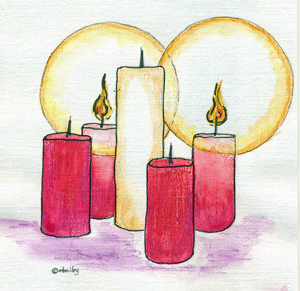
There is much about Advent to enjoy, the Advent wreaths found in our churches where they have four candles to be lit each Sunday and one for Christmas Day. But in the midst of our church we know that just as we prepare for Christmas, so we have to make ready to welcome Jesus in our lives. Are you ready for the coming of Jesus?