
 Ordinary 14 - Jesus said come unto me
Weekly Bible Notes and Worship Resources
Ordinary 14 Year A
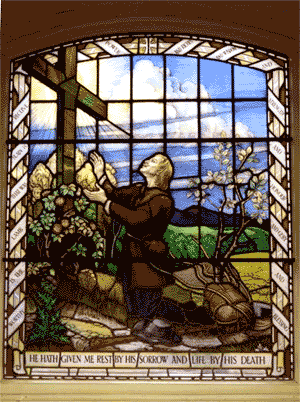
Introduction
John Bunyan wrote Pilgrim's Progress here in Bedford. His story is told the world over of how Pilgrim journeyed and found his burden lifted.
In our reading today from Matthew we read the passage of scripture from Matthew in which Jesus spoke of lifting our burdens.
"Come to me, all you who are weary and burdened, and I will give you
rest. Take my yoke upon you and learn from me,
for I am gentle and
humble in heart, and you will find rest for your souls. For my yoke is
easy and my burden is light.'
We often think of religion as being something which makes us feel guilty. Jesus speaks in a way which shows that is not God's intention. Jesus came that we might have freedom from guilt and a release from those things which bring fear. Jesus came to bring peace to all the souls who put their trust in him.
Opening Verses of Scripture Galatians Chapter 5 Verse 1
Stand fast therefore in the liberty wherewith Christ hath made us free, and be not entangled again with the yoke of bondage.
Collect Prayer for the Day — Before we read we pray
O God, the protector of all who trust in you,
without whom nothing is strong, nothing is holy:
increase and multiply upon us your mercy;
that with you as our ruler and guide
we may so pass through things temporal
that we lose not our hold on things eternal;
grant this, heavenly Father,
for our Lord Jesus Christ’s sake,
who is alive and reigns with you,
in the unity of the Holy Spirit,
one God, now and for ever. CW
Gracious Father, by the obedience of Jesus you brought salvation to our wayward world: draw us into harmony with your will, that we may find all things restored in him, our Saviour Jesus Christ. CW
First Bible Reading Genesis 24:34-38, 42-49, 58-67
The servant whom Abraham had sent said to Laban: ‘I am Abraham’s servant. The LORD has greatly blessed my master, and he has become wealthy; he has given him flocks and herds, silver and gold, male and female slaves, camels and donkeys. And Sarah my master’s wife bore a son to my master when she was old; and he has given him all that he has. My master made me swear, saying, “You shall not take a wife for my son from the daughters of the Canaanites, in whose land I live; 38but you shall go to my father’s house, to my kindred, and get a wife for my son.”
I came today to the spring, and said, “O LORD, the God of my master Abraham, if now you will only make successful the way I am going! I am standing here by the spring of water; let the young woman who comes out to draw, to whom I shall say, ‘Please give me a little water from your jar to drink,’ and who will say to me, ‘Drink, and I will draw for your camels also’ – let her be the woman whom the LORD has appointed for my master’s son.”
Before I had finished speaking in my heart, there was Rebekah coming out with her water jar on her shoulder; and she went down to the spring, and drew. I said to her, “Please let me drink.” She quickly let down her jar from her shoulder, and said, “Drink, and I will also water your camels.” So I drank, and she also watered the camels. Then I asked her, “Whose daughter are you?” She said, “The daughter of Bethuel, Nahor’s son, whom Milcah bore to him.” So I put the ring on her nose, and the bracelets on her arms. Then I bowed my head and worshipped the LORD, and blessed the LORD, the God of my master Abraham, who had led me by the right way to obtain the daughter of my master’s kinsman for his son. Now then, if you will deal loyally and truly with my master, tell me; and if not, tell me, so that I may turn either to the right hand or to the left.’
And they called Rebekah, and said to her, ‘Will you go with this man?’ She said, ‘I will.’ So they sent away their sister Rebekah and her nurse along with Abraham’s servant and his men. And they blessed Rebekah and said to her,
‘May you, our sister, become
thousands of myriads;
may your offspring gain possession
of the gates of their foes.’
Then Rebekah and her maids rose up, mounted the camels, and followed the man; thus the servant took Rebekah, and went his way.
Now Isaac had come from Beer-lahai-roi, and was settled in the Negeb. Isaac went out in the evening to walk in the field; and looking up, he saw camels coming. And Rebekah looked up, and when she saw Isaac, she slipped quickly from the camel, and said to the servant, ‘Who is the man over there, walking in the field to meet us?’ The servant said, ‘It is my master.’ So she took her veil and covered herself. And the servant told Isaac all the things that he had done. Then Isaac brought her into his mother Sarah’s tent. He took Rebekah, and she became his wife; and he loved her. So Isaac was comforted after his mother’s death. NRSV
Second Reading Romans Chapter 7 : 15-25a
I do not understand my own actions. For I do not do what I want, but I do the very thing I hate. Now if I do what I do not want, I agree that the law is good. But in fact it is no longer I that do it, but sin that dwells within me. For I know that nothing good dwells within me, that is, in my flesh. I can will what is right, but I cannot do it. For I do not do the good I want, but the evil I do not want is what I do. Now if I do what I do not want, it is no longer I that do it, but sin that dwells within me.
So I find it to be a law that when I want to do what is good, evil lies close at hand. For I delight in the law of God in my inmost self, but I see in my members another law at war with the law of my mind, making me captive to the law of sin that dwells in my members. Wretched man that I am! Who will rescue me from this body of death? Thanks be to God through Jesus Christ our Lord! NRSV
Gospel Reading Matthew Chapter 11 : 16 - 19, 25 - 30
At that time Jesus said, ‘To what will I compare this generation? It is like children sitting in the market-places and calling to one another,
“We played the flute for you, and you did not dance;
we wailed, and you did not mourn.”
For John came neither eating nor drinking, and they say, “He has a demon”; the Son of Man came eating and drinking, and they say, “Look, a glutton and a drunkard, a friend of tax-collectors and sinners!” Yet wisdom is vindicated by her deeds.
I thank you, Father, Lord of heaven and earth, because you have hidden these things from the wise and the intelligent and have revealed them to infants; yes, Father, for such was your gracious will. All things have been handed over to me by my Father; and no one knows the Son except the Father, and no one knows the Father except the Son and anyone to whom the Son chooses to reveal him.
Come to me, all you that are weary and are carrying heavy burdens, and I will give you rest. Take my yoke upon you, and learn from me; for I am gentle and humble in heart, and you will find rest for your souls. For my yoke is easy, and my burden is light.’ NRSV
Post Communion Sentence
Eternal God, comfort of the afflicted and healer of the broken, you have fed us at the table of life and hope: teach us the ways of gentleness and peace, that all the world may acknowledge the kingdom of your Son, Jesus Christ our Lord. CW
Commentary
Commentary
‘Come to me, all you who are weary and burdened, and I will give you rest. Take my yoke upon you and learn from me, for I am gentle and humble in heart, and you will find rest for your souls. For my yoke is easy and my burden is light.' Jesus Matthew Chapter 11
Jesus looked at the religious leaders in the synagogues and the temple in Jerusalem and he was not impressed. Instead of telling people of a God who wanted love and mercy, they spent their time making people feel guilty for breaking rules.
They had hundreds of rules about things like
- What clothes you could wear and what clothes it was forbidden to wear
- What foods you could eat and what foods were considered unclean and you could not eat.
- There were lots of rules about special days and what could and could not be done on those days. Such as the Sabbath.
- Later in this chapter we read about how the disciples of Jesus got into trouble with the religious leaders because they picked grain and ate it as they were going through the field.
Jesus said that these rules were wrong. Instead of bringing people closer to God, they just made them feel guilty that they couldn't keep them properly. Jesus said they were like burdens.
Mat 23:4 For they bind heavy burdens and grievous to be borne, and lay them on men's shoulders; but they themselves will not move them with one of their fingers.
Luk 11:46 And he said, Woe unto you also, ye lawyers! for ye lade men with burdens grievous to be borne, and ye yourselves touch not the burdens with one of your fingers.
Jesus believed that all of the rules and regulations could be summed up very simply and he gave a 'Golden Rule' to his disciples earlier in this Gospel
So in everything, do to others what you would have them do to you, for this sums up the law and the prophets Matthew Chapter 7:12
Jesus belived that the obssession with rules and their interpretation missed the point. What God wanted was for people to simply behave with love towards one another and God. Instead of bringing people closer to God, the laws had just weighed everybody down.
It was in this context that Jesus said the words which we hear in our reading today, words which are some of the most famous in the whole Bible
‘Come to me, all you who are weary and burdened, and I will give you rest.
Take my yoke upon you and learn from me, for I am gentle and humble in heart, and you will find rest for your souls. For my yoke is easy and my burden is light.'
So the first statement which Jesus makes is an invitation to come to him.
Who does he invite ? He invites those who are weary and burdened, those who are looking for rest. Doesn't that include everybody here today ? I won’t ask you to put your hand up but you will know if you have a burden.
- It might be a physical condition which is getting you down.
- It might be a worry for somebody else who is ill, a friend or member of the family who has cancer or a disease
- Perhaps it is a worry over debt, worry over your job, or something which you can't cope with
- It might be a guilty thing which you can’t forgive yourself for, or perhaps you find it hard to forgive somebody else
- We are spiritual beings and we may have a spiritual kind of weariness.
I have no idea what burdens there might be, but I do know that the burdens of life we just cannot carry by ourselves. All of us from time to time find living in this world a bit overwhelming. We are weighed down by worries, responsibilities, aches and pains. So why not turn to Jesus for help?
Jesus tells us today that if we have a burden, something difficult in our lives, that there is no reason to struggle with these burdens which are too heavy for you. If you will turn to Jesus, he will help you carry your burdens. And there is no burden too heavy for Jesus.
There might be many reasons why we do not ask for God’s help
- Perhaps we don’t think we’re actually deserving of it.
- Some people see themselves as too broken to be of any use or value.
God never ever sees us this way. God knows where we are broken. God knows where we are hurting and aching and wants only to take that burden from us. God loves us and can use us, and the only qualification this morning is being weary and burdened and wanting rest.
The second statement which Jesus makes is an invitation to take his yoke upon us
A yoke might seem an unlikely way of finding rest ! When Jesus spoke these words the yoke was a familiar symbol of burden. Yokes were laid on the necks and shoulders of oxen and also on prisoners of war and slaves. Clearly when Jesus promises us rest, he is not calling us to a life of idleness.
When Jesus says take my yoke upon you, he is offering to walk alongside us and share the load. This is the way which we are meant to live our lives, with God at our side, helping us, working with us, showing us the way.
Is it any wonder that so many people find life difficult when they try to get through in their own strength?
It is interesting to remember that Jesus was a carpenter, as such he would have made yokes. The yoke joined two animals together, they were partnered, and so a young animal could learn from a trained animal who shared the load.
In using these words Jesus offers himself as a partner to you and me, helping to pull the load. There is a load to be pulled, there is no getting away from that. Jesus never offers his followers an easy life, he offers a full and rewarding life. The truth is that whatever we decide about whether to accept the invitation of Jesus to walk beside, we will nevertheless be pulling a load, everyone one of us is like the animal ploughing through the field. The question if whether we seek God’s help or try to do it alone.
There is probably not a person here today who is not carrying a burden of some kind, because simply to live is to toil. So these words are spoken to us all. If we choose to walk without God, to seek strength in other places, then we will be disappointed. Searching after fulfilment elsewhere will only burden our hearts and souls further.
Jesus promises to share that burden. He offers not a life of ease, but a life of service, to live in his way. If we decide to do this then we will find it comfortable for our souls, we will find walking with him to bring peace and fulfillment. You may not have had a good experience of religion, you may not have thought of God as kind. This morning we hear these words of Jesus that he is humble and kind and we are are encouraged to know that he will walk with us day by day to help us find fulfillment and peace for our souls.
Meditation
Rabbis spoke of the yoke of the Law, with its many regulations, as something people took on themselves to steer and guide them down God's paths in life. But it seems to have been a common complaint, addressed above all to the Scribes and Pharisees as interpreters of God's Law, that their teachings had become complicated and difficult to follow, a burden rather than a guide to holy living, a set of rules which were turning people away from God rather than to Him. By contrast, Jesus' way is not a complex set of rules - He merely says love God and love each other. His invitation is beautiful in its simplicity. It is not a summons to idol worship of Jesus, but a call to learn a new way, especially a new way of interpreting and understanding God's will. It is not a call to heaviness, but a call to lightness of being. It contrasts with the calls of those who would interpret scripture as demand and stricture as the Rabbis seem to have done. Spiritual elitism and false piety seems to repel many more than it attracts. The best guides to follow are those who simply live out God’s love and precepts and practice what they preach.
Hymns
- Crown him with many crowns Tune Diademata
- Jesus the name high over all Tune Lydia
- Praise my soul the King of heaven Tune Praise my soul
- I heard the voice of Jesus say Tune Kingsfold
- Lift up your hearts! We lift them to the Lord Tune Woodlands
Prayers for Sunday and the week ahead

Prayer is a plant, the seed of which is sown in the heart of every Christian,
if it is well cultivated and nourished it will produce fruit, but if it is neglected,
it will wither and die.
Praise to you, God, for all your work among us. Yours is the vigour in creation, yours is the impulse in our new discoveries. Make us adventurous, yet reverent and hopeful in all we do. Amen.
Lord, quieten us down, as we place into your hands those for whom we want to pray. We know that you love them with a greater love than we could ever imagine. In the stillness we are here, with you, for them. Amen
Lord God, we thank you for calling us into the company of those who trust in Christ and seek to obey His will. May your Spirit guide and strengthen us in mission and service to your world; for we are strangers no longer but pilgrims together on the way to your Kingdom. Amen Prayer of the Inter Church Process (The Swanwick Declaration)
God the Sender, send you; God the Sent, go with us; God the Strengthener of those who go, empower you, that you may go to do His will; and the blessing of God Almighty, the Father, the Son, and the Holy Spirit, be among you and remain with you always. Amen
Jesus, by your wounded feet, direct our path. Jesus, by your nailed hands, move us to deeds of love. Jesus, by your pierced side, purify our desires. Jesus, by your crown of thorns, annihilate our pride. Jesus by your broken heart, knit ours to yours. Amen. Richard Crashaw (1613-1649)
Additional Material
Meditation
What Jesus offers is not freedom from work, but freedom from onerous labor. Soul-sick weariness is not the inevitable consequence of all work, but rather of work to which we are ill-suited, of work extracted under compulsion and motivated by fear, or of work performed in the face of futility. There is also the weariness that comes from having nothing at all to do that truly matters. The easy yoke means having something to do: a purpose that demands your all and summons forth your best. It means work that is motivated by a passionate desire to see God's kingdom realized. It means work toward a certain future in which all of God's dreams will finally come true. To accept the yoke of the gentle and humble Lord is to embrace the worthy task that puts the soul at ease. Lance Pape Feasting on the Word, Year A Vol. 3, p. 217
Besides, it is my experience that more people today are led to God by the emptiness they find in success than through being broken by hard experiences--although, of course, the ways to God are infinite, and there is no shortage of the latter. Just when they attain what they always dreamed of, when they get to the position they have long worked for, they find themselves restless and unsatisfied. They ask themselves--tell themselves--"There must be more than this!" Michael Novak, 20th century
Commentary
Things are not always what they seem!
In Jesus' time work animals (usually oxen) worked in pairs, yoked together
by a hand-carved wooden frame to share the load. The design pressed against
the windpipes of horses and choked them, so work horses weren't used in the
field until the invention of the horse collar and harness much later in
Northern Europe. In the Gospel passage Jesus is offering us the opportunity
to share our load with Him. He also identifies his mission with John the
Baptist's; but explains that they are different. John's mission was to
proclaim the imminent arrival of the Kingdom and urge people to be ready for
it. In Jesus not only is the kingdom announced; it is coming to reality,
both now and in the future.
The words from the Gospel reading, "Come to me, all you who are weary and
burdened, and I will give you rest.", were known in the Book of Common
Prayer as The Comfortable Words and were said by the Priest right after the
Confession and Absolution in the service of Holy Communion. They were
introduced with the words, "Hear what comfortable words our Saviour Christ
saith unto all that truly turn to him...". They reminded us of the hope we
have in God, of our renewed reconciliation and peace we have with Him
through our new life in Christ.
God had given his people basic guidelines for holy life, but the Pharisees
had ended up making God's Law inaccessible and impossible to follow. Jesus
assures his disciples that by learning and interpreting God's Law in His
way, they will not be intimidated by complexity or burdened, and condemned
to failure, by the minutiae of details and esoteric interpretation. Jesus
points out the original simplicity of God's Covenant and Law, and
demonstrates that all they need to guide and steer them is a simple
uncomplicated faith in Him, through which everyone can find true peace,
rest, and refreshment.
By putting the Comfortable Words back into the context of Matthew's Gospel,
they have a depth that sometimes is not immediately obvious from their
Eucharistic setting. Absolution and forgiveness is not conditional upon our
ability to follow complicated rules, but is a gift from God, given freely
out of His incomparable and compassionate riches. And as we find peace,
refreshment and rest for ourselves we are called to live the kind of lives
through which others, too, can find God's peace, God's refreshing grace, and
the joy of placing their lives in God's hands.
In taking Jesus' yoke upon us we not only share our burdens with Him, He
asks us to share His burden too. Our mission, like John's, is to proclaim
the imminent arrival of the Kingdom and urge people to be ready for it. It’s
also like Jesus', to demonstrate this kingdom is a reality, both now and in
the future. God will not ask too much from us, nor should we offer too
little. His yoke is there to guide us, not to choke us. And we have the
assurance that being yoked together, walking in step with God, we are never
far from each other. Rev Dr Sam Cappleman.
In today’s gospel reading, as we see when we read the rest of the passage, Jesus is not rebelling against the law and the House of Israel; He’s bringing it to fulfilment. Rather than trying to live by a set of rules and standards that no one was ever going to achieve, Jesus offers a relationship with God through a relationship with Him. Through Jesus a new way of engaging with God was being established which didn’t depend on a set of complex rules and regulations which needed further expansion and explanation, but on a relationship. God had given his people basic guidelines for holy life, but perhaps unwittingly, the Pharisees had made God's Law inaccessible and almost impossible to follow. In Jewish tradition these laws were not just the 10 commandments but the myriad of other laws and teachings that were based on the Torah and which were taught and propagated by the Pharisees and the Sanhedrin as the supreme court of the time. There are 613 Mitzvot (commandments) based on the Torah alone, 248 positive ones, which bring us closer to God, and 365 negative ones which forbid specific actions to stop Jews getting further away from God. Tradition has it that there are 248 bones in a male body, and there are 365 days in a normal year. In the gospel reading today, Jesus is making reference to this myriad of rules and regulations that were laid down in Jewish law to regulate every aspect of life. In Hebrew the ‘law’ can be translated as ‘halakha’, which can be interpreted as ‘the way to go’. Jesus offers us His ‘halakha’, not as a set of rules, but as an invitation to walk in His way, with His yoke upon us, loving God and loving each other. To know the Father as a Son does, not through esoteric or academic wisdom. He says,
‘Come unto me all that travail and are heavy laden, take my yoke upon you and learn from me’.
The burden to which Jesus refers was that heaviness of those things which weigh us down and the strictures and rules we place on ourselves. In the new way of living and being that Jesus offers those burdens could be replaced by the lightness and the gentleness of a personal relationship with Him. He offers an opportunity to discover more of God by following Him. Jesus was offering the hearers a choice. They could continue to follow the old way and live under the yoke of the law and their burdens or they could choose the new way with Him and find rest and peace.
Jesus offers us the same choice too. Not that we are under the yoke of the Jewish law, but we have our own yokes. We can feel weighted down by our fears, our anxiety and our guilt. Things that we’re worried about, things that we are afraid of, things that lurk in our conscience from times past. And it’s not just the things which may be beyond our control. We can also make our own yokes. We form our own sets of rules, or we try to conform to the beliefs and standards of others, all of which can begin to increasingly govern our lives and restrict us from having the freedom which Jesus offers all who turn to Him. We just don’t feel as if we are in control of our lives. We find ourselves conforming to the norms and values around us rather than being free to be ourselves. And before long our own culture, values, tastes and behaviours have also become a yoke and a burden we are bearing – and it’s as easy to feel just as trapped as the people Jesus was referring to in the gospel reading. Whatever the burdens, then and now Jesus invites all to come to Him; He stood alongside those who were under the law and outside the law, the religious and the faithful but also the ungodly, the weary and the anxious, and He still does, bearing our condemnation and our heaviness and revealing the Father’s heart in the lightness of His love. He invites us to walk with Him whoever we are and take on His yoke. And whilst Jesus’ yoke is light, His invitation open to all, our response needs to be whole hearted. Just as He accepts all of us; we need to accept all of Him. We can’t just choose the bits and times we like, like the children and those sitting in the market place who just take the parts they want and who only join in when they feel like it. It is in this true and full commitment to Jesus we find true lightness and refreshment in our faith.
The crowd knew if they ignored Jesus’ offer they had nowhere else to go. Neither do we. In taking Jesus' yoke upon us we not only share our burdens with Him, He asks us to share His burden too. Our mission, like John the Baptist, is to proclaim the imminent arrival of the Kingdom and urge people to be ready for it. It’s also like the mission of Jesus, to demonstrate this kingdom is a reality, both now and in the future. God will not ask too much from us, nor should we offer too little. His yoke is there to guide us, not to choke us. And we have the assurance that being yoked together, walking in step with God, we are never far from each other. Sam Cappleman.
Commentary : Attributed to John Chrysostom 'I am gentle and humble in heart'
Our Master is always the same, gentle and benevolent. In his constant
concern for our salvation, he says explicitly in the gospel just read to us:
Come, learn from me, for I am gentle and humble in heart.
What great condescension on the part of the Creator! And yet the
creature feels no shame!
Come, learn from me.
The Master came to console his fallen servants. This is how Christ
treats us. He shows pity when a sinner deserves punishment. When the race
that angers him deserves to be annihilated, he addresses the guilty ones in
the kindly words:
Come, learn from me, for I am gentle and humble in heart.
God is humble, and we are proud! The judge is gentle; the criminal arrogant!
The potter speaks in lowered voice; the clay discourses in the tones of a
king!
Come, learn from me, for I am gentle and humble in heart.
Our master carries a whip not to wound, but to heal us. Reflect upon his
indescribable kindness. Who could fail to love a master who never strikes
his servants? Who would not marvel at a judge who beseeches a condemned
criminal? Surely the self-abasement of these words must astound you.
I am the Creator and I love my work. I am the sculptor and I care for what I
have made. If I thought of my dignity, I should not rescue fallen humankind.
If I failed to treat its incurable sickness with fitting remedies, it would
never recover its strength. If I did not console it, it would die. If I did
nothing but threaten it, it would perish. This is why I apply the salve of
kindness to it where it lies. Compassionately I bend down very low in order
to raise it up. No one standing erect can lift a fallen man without putting
a hand down to him.
Come, learn from me, for I am gentle and humble in heart.
I do not make a show of words; I have left you the proof of my deeds. You
can see that I am gentle and humble in heart from what I have become.
Consider my nature, reflect upon my dignity, and marvel at the condescension
I have shown you. Think of where I came from, and of where I am as I speak
to you. Heaven is my throne, yet I talk to you standing on the earth! I am
glorified on high, but because I am long-suffering I am not angry with you,
for I am gentle and humble in heart.
(Homily on Saint Bassus: Bareille, t. 4, 509-510)
Commentary
In today’s gospel Jesus encourages us with the comfortable words with which we started our service,‘Come to me, all you who are weary and burdened, and I will give you rest. Take my yoke upon you and learn from me,
for I am gentle and humble in heart, and you will find rest for your souls. For my yoke is easy and my burden is light.'
Perhaps we should start by thinking about what Jesus meant by ‘carrying his yoke.’ Jewish people at the time spoke of carrying the yoke of God’s law and the yoke of his kingdom. This was done by acknowledging that God was one and by keeping his commandments. So when Jesus spoke about his yoke being ‘easy’ and his burden ‘light,’ he was effectively contrasting the easy life which would be enjoyed by those who followed him, with the burdensome life for those under the old Jewish law.
Now that is all well and done but was Jesus being sincere? You may think that life for his followers was anything but easy, remember this is the Jesus who told his disciples that they had to take up a cross, an instrument of death, if they really wanted to be his disciples. Think, is it easy to follow the teachings of Jesus? To follow Jesus means a life of seeing the best in people, going the extra mile, forgiving endlessly, sharing all that we have with those in need. So in what way is following Jesus easy?
The answer must take into consideration the contrast between the life of those Jews who tried to be obedient to God by keeping a whole load of rules and regulations as they obeyed the law of Moses. This yoke was a hard one to bear and led to a life of rule keeping under the old covenant. This is made explicit in the verses which follow in Chapter 12. Here the disciples of Jesus are attacked by the Pharisees, who were strict adherents of the Mosaic law, for plucking and eating grain on the Sabbath. Jesus defends his disciples for breaking the Sabbath by declaring that he as ’Son of Man’ was ‘Lord of the Sabbath.’ Jesus is replacing the old law which never removed the guilt of sin, with nothing less than himself. Jesus is the New Covenant and he offers the opportunity to escape from the old religion which piles guilt and misery and demands sacrifice. The followers will no longer have to worry about a God who condemns and demands the blood of innocent animals to be spilled to make peace. They will no longer require priests to offer sacrifices on their behalf.
Jesus was promising a new lifestyle in which his followers would discover peace from seeking to live out his teachings. The way of following Jesus would demand hardship and suffering, but the grace and salvation discovered in the heart of those who trusted in Jesus would mean that their burden of sin would be lifted and guilt would be no more. Charles Royden
Prayers
Praise to you, God, for all your work among us. Yours is
the vigour in creation, yours is the impulse in our new discoveries. Make
us adventurous, yet reverent and hopeful in all we do. Amen.
Lord, quieten us down, as we place into your hands those for whom we want
to pray. We know that you love them with a greater love than we could ever
imagine. In the stillness we are here, with you, for them. Amen
Lord God, we thank you for calling us into the company of those who trust
in Christ and seek to obey His will. May your Spirit guide and strengthen
us in mission and service to your world; for we are strangers no longer
but pilgrims together on the way to your Kingdom. Amen
Prayer of the Inter Church Process (The Swanwick Declaration)
God the Sender, send you; God the Sent, go with us; God the Strengthener
of those who go, empower you, that you may go to do His will; and the
blessing of God Almighty, the Father, the Son, and the Holy Spirit, be
among you and remain with you always. Amen
Thank you God for opportunity. Here is a new day, untouched by my hand, but held in yours. I need you and you have chosen to need me. Together we can bring to fruition some of life's endless possibilities. Thank you God. Amen
The love of the Lord Jesus draw you to Himself, the power of the Lord Jesus strengthen you in His service, the joy of the Lord Jesus fill your hearts, and the blessing of God Almighty, Father, Son and Holy Spirit, be among you and remain with you always. Amen