
Weekly Bible Notes and Worship Resources
Third Sunday of Epiphany Year A, Colour = White
Introduction
Jesus called ordinary people to follow him and they left what they were doing behind. Their lives were changed for ever as they listened to his teaching and decided that what he said made sense. Today Jesus still calls people and they respond to his message. They too find that in the midst of a chaotic and confused world, Jesus gives to them peace and joy. Jesus offers timeless truth and as we listen to his words we are drawn into the love of God. It really does make sense to take time in the midst of our busyness to listen afresh to Jesus. This is one things that really does deserve our attention as those first followers quickly realised.
Opening Verse of Scripture
The LORD is my light and my salvation— whom shall I fear? The LORD is the stronghold of my life— of whom shall I be afraid? Psalm 27 v 1
Collect Prayer for the Day — Before we read we pray
Almighty God, whose Son revealed in signs and miracles the wonder of your saving presence: renew your people with your heavenly grace, and in all our weakness sustain us by your mighty power; through Jesus Christ your Son our Lord, who is alive and reigns with you, in the unity of the Holy Spirit, one God, now and for ever. CW
God of all mercy, your Son proclaimed good news to the poor, release to the captives, and freedom to the oppressed: anoint us with your Holy Spirit and set all your people free to praise you in Christ our Lord. CW
First Bible Reading Isaiah 9:1-4
But there will be no gloom for those who were in anguish. In the former time he brought into contempt the land of Zebulun and the land of Naphtali, but in the latter time he will make glorious the way of the sea, the land beyond the Jordan, Galilee of the nations. The people who walked in darkness have seen a great light; those who lived in a land of deep darkness – on them light has shined. You have multiplied the nation, you have increased its joy; they rejoice before you as with joy at the harvest, as people exult when dividing plunder. For the yoke of their burden, and the bar across their shoulders, the rod of their oppressor, you have broken as on the day of Midian. NRSV
Second Reading 1 Corinthians 1: 10-18
I appeal to you, brothers and sisters, by the name of our Lord Jesus Christ, that all of you be in agreement and that there be no divisions among you, but that you be united in the same mind and the same purpose. For it has been reported to me by Chloe’s people that there are quarrels among you, my brothers and sisters. What I mean is that each of you says, ‘I belong to Paul,’ or ‘I belong to Apollos,’ or ‘I belong to Cephas,’ or ‘I belong to Christ.’ Has Christ been divided? Was Paul crucified for you? Or were you baptized in the name of Paul? I thank God that I baptized none of you except Crispus and Gaius, so that no one can say that you were baptized in my name. I did baptize also the household of Stephanas; beyond that, I do not know whether I baptized anyone else. For Christ did not send me to baptize but to proclaim the gospel, and not with eloquent wisdom, so that the cross of Christ might not be emptied of its power. For the message about the cross is foolishness to those who are perishing, but to us who are being saved it is the power of God. NRSV
Gospel Reading Matthew 4:12-23
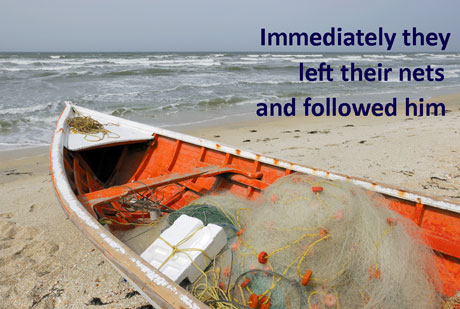
When Jesus heard that John had been arrested, he withdrew to Galilee. He left Nazareth and made his home in Capernaum by the lake, in the territory of Zebulun and Naphtali, so that what had been spoken through the prophet Isaiah might be fulfilled: ‘Land of Zebulun, land of Naphtali, on the road by the sea, across the Jordan, Galilee of the Gentiles – the people who sat in darkness have seen a great light, and for those who sat in the region and shadow of death light has dawned.’From that time Jesus began to proclaim, ‘Repent, for the kingdom of heaven has come near.’ As he walked by the Sea of Galilee, he saw two brothers, Simon, who is called Peter, and Andrew his brother, casting a net into the lake – for they were fishermen. And he said to them, ‘Follow me, and I will make you fish for people.’ Immediately they left their nets and followed him. As he went from there, he saw two other brothers, James son of Zebedee and his brother John, in the boat with their father Zebedee, mending their nets, and he called them. Immediately they left the boat and their father, and followed him. Jesus went throughout Galilee, teaching in their synagogues and proclaiming the good news of the kingdom and curing every disease and every sickness among the people. NRSV
Post Communion Prayer
Almighty Father, whose Son our Saviour Jesus Christ is the light of the world: may your people, illumined by your word and sacraments, shine with the radiance of his glory, that he may be known, worshipped, and obeyed to the ends of the earth; for he is alive and reigns, now and for ever. CW
Commentary
Unity in Christ
The Old Testament reading from Isaiah is very similar to the Christmas reading from this chapter. The verses about the birth of the Davidic king are dropped at the end, but the reading starts with the reference to "the land of Zebulun and the land of Naphtali" and "Galilee of the Gentiles. This passage is echoed in the gospel reading, where Matthew introduces it to mark the beginning of the Galilean ministry. Read on Christmas night, it relates to the nativity of Christ; it was then that light dawned in the darkness. Read now, it refers to the beginning of Jesus' ministry. His nativity and His ministry are intertwined; both are aspects of the single Christ-event, the coming of light into the darkness of the world. It is with His coming to Galilee and the launching of His proclamation that people began to become aware of the light that was shining.
As He went throughout Galilee, that light touched every aspect of people’s lives and every aspect of society, He went through the region, ‘teaching in their synagogues, preaching the good news of the kingdom, and healing every disease and sickness among the people’. One of the aspects of the Bishop’s initiative, ‘Living God’s Love’, is about making disciples. As Jesus starts out in His ministry, He calls His disciples. From what we can tell, it would appear that there was not a great flurry of activity or multiple signs or miracles to attract attention to Himself or prove His credentials before Jesus called His disciples to follow Him. They did not seem to chose to follow Jesus because they were ‘wowed’ by witnessing acts of His supernatural activity or power, they followed Jesus merely because He called them and there was something in that call which was deeply attractive, attractive enough for men who had regular jobs and employment to drop everything and follow Him. At the most, all the disciples would have experienced of Jesus would be to have heard Him preach a few times. And yet, they chose to follow Him and become a group of people who would be united with Him in spreading the good news. People such as Simon-Peter, Andrew, James and John. Fishermen, not individuals known as great speakers or charismatic leaders, but everyday people who heard the call of Jesus and responded.
At this early stage of ministry they were probably very unclear what following Jesus would mean, but they stepped out in faith, left their security behind and followed Him. And throughout his ministry we know that the disciples often talked to each other, trying to work out what a particular parable or action of Jesus signified. Frequently this is portrayed by commentators as a negative thing, as if the disciples were grumbling about what they had got themselves into, wondering why people didn’t see things the way they did, and even questioning the concept of Jesus as the Messiah and His authority. But this isn’t the case. Often they were more concerned with understanding the significance of something Jesus had said, trying to work out the implications of some of His actions and radical approach and access to His Father God.
When we are following Christ, God does not mind if we have questions, does not mind if we don’t always understand what is happening and why things are the way they are in the world. He wants us, as spiritual descendants of those first disciples, to follow in their footsteps, faithfully following Him as best as we are able with our imperfect understanding of Him and His ways. The uniqueness of the Christian faith is that it is dependent on the uniqueness of Christ, not on a perfect knowledge or understanding of God. And in that uniqueness there is absolute unity, based on the unshakable truths of the gospel message. A unity that Paul was keen to stress to the Corinthian Church. We may express our Christian faith in different ways, but as Christians we are all uniquely united in Christ. Our challenge is to live out that unity every day. Sam Cappleman
Meditation
Jesus' act of calling disciples would have been a common event in the Middle East. Usually, a person with a cause or grievance invites people to join him in promoting the cause or resolving the grievance. The disciples didn’t quite understand Jesus’ cause but they certainly followed Him. They must have believed it too, because they dropped everything to follow him. In unified groups there is strength. When people look at the Church and Christians today, how united do they see the people of God and Christ’s disciples?
Hymns
- Christ is made the sure foundation (Tune Westminter Abbey)
- For I’m building a people of power
- Will you come and follow me
- May the mind of Christ my saviour (Tune St Leonard)
- All my hope on God is founded (Tune Michael)
Prayers for Sunday and the week ahead

Prayer is a plant, the seed of which is sown in the heart of every Christian.
If it is well cultivated and nourished it will produce fruit, but if it is neglected, it will wither and die."
O Christ, my Way to the God of all salvation, people of other faiths believe they have their own salvation faith. Be with them dear Lord, to encourage them on their way to their own Jerusalem, so that we all find ourselves with the spirits of just people made perfect, with the saints of every age and faith, in the presence of the eternal God, the God of many names, Creator, Lover, Saviour of us all. Amen.
Eternal God, whose image lies in the hearts of all people, we live among peoples whose ways are different from ours, whose faiths are foreign to us, whose tongues are unintelligible to us. Help us to remember that you love all people with your great love, that all religion is an attempt to respond to you, that the yearnings of other hearts are much like our own and are known to you. Help us to recognise you in the words of truth, the things of beauty, the actions of love about us. We pray through Christ, who is a stranger to no land more than another, and to every land no less than other.
We pray for all humanity; though divided into nations and races, yet all people are your children, drawing from you their life and being, commanded by you to obey your laws, each in accordance with the power to know and understand them. Case hatred and strife to vanish, that abiding peace may fill the earth, and humanity everywhere be blessed with the fruit of peace.
So shall the spirit of family among people show forth their faith that you are Father of all Amen.
Additional Resources
Meditation
But now, this is what the LORD says—he who created you, O Jacob, he who formed you, O Israel: "Fear not, for I have redeemed you; I have summoned you by name; you are mine. Isaiah 43:1
Sir Thomas Royden was a director of Cunard in Liverpool which built The Queen Mary in 1934. He is said to have told King George V that he wanted to name it after the greatest queen the country had known. King George assumed that Thomas was referring to his own wife Queen Mary and said 'That is the greatest compliment ever paid to my wife. I’ll ask her if your ship may be named after her.' It was only years later that the shipping company mentioned that it had been intending to call the ship 'The Queen Victoria' !
Names are significant, we like it when people remember our names. So it is significant that in Isaiah God is said to have remembered the names of his people. In Isaiah 49:15 we read
'Can a mother forget the baby at her breast and have no compassion on the child she has borne?
Though she may forget, I will not forget you!See, I have engraved you on the palms of my hands;
Lord God we thank you that we are your children and you know each one of us by name. Help us to remember the names of those we meet knowing that each one of us is precious to you.
Commentary Notes
Matthew tells us that following John's arrest Jesus moves from Nazareth to Capernaum. It will not end well for John, as now there is state violence which kills the innocent. With the forunner soon to be killed, Jesus must now take over and so he goes to Galilee, not to hide, because the territory is governed by Herod Antipas who has arreested John!. Jesus went to Capernaumthe largest town on the Sea of Galilee, and had the largest harbor. It was a busy place and somewhere to spread news from across the region
Jesus moves from Nazareth, which is south west of the Sea of Galilee to Capernaum, which is on the northwest shore--the territory
of Naphtali, but not Zebulon. Matthew knew this perfectly well. In citing the prophet Isaiah regarding Naphtali and Zebulon, Matthew's purpose
is not to say that the Isaiah passage literally prophesies the future.
Matthew is giving us a glimpse of Jesus' later mission to the gentiles, for whilst his mission is to the lost sheep of the house of Israel (15:35), it will grow to include Galilee of the gentiles. Matthew also changes the Isaiah text. The "toward the sea" in Isaiah 9:1-2 refers to the Meditteranean Sea. Matthew means "by the sea" to be the Sea of Galilee. In Capernaum, Jesus proclaims, "Repent, for the kingdom of heaven has come near." John had said these exact words in "the wilderness of Judea." Here, Jesus says them in "Galilee of the gentiles." Not only are John and Jesus in continuity, but the "kingdom of heaven movement" is spreading throughout the region.